Tuesday, 5 July 2011

Tour de Fleece days 1 to 3

The Tour de France is an annual bicycle race held in France.

The Tour de Fleece is an annual event on Ravelry.com where participants spin-along during the Tour de France - they spin, we spin.

We join any one of the many teams - I'm in 3 for my first year - and post photos our fleece/fibre and finished yarn.  Oh, and have great fun while doing it.

So it started on Saturday  2 July.  I am of course still up in Orkney and on Saturday we were travelling from Flotta to North Ronaldsay - in a very tiny plane.  Not sure about how things would work out re TdF spinning I decided to crack off very early in the morning and get some spun.  So I worked through some of the Cheviot fleece I'd washed in Newcastle and managed to get just over 50 m of it spun and plied at about worsted weight.  I'd carded it into rolags the evening before.  Yes, this is what I look like very early in the morning before breakfast!


The travelling to North Ronaldsay went very smoothly despite my worries regarding the spinning wheel - I had to take the Sidekick so it would fit into a case - and the weight limit of 15kg each on the plane.  When we arrived Liz took us for a walk along the beach and that's when I had the mad/brilliant idea - take the sidekick down to the beach and spin there!  I'd spotted lots of bits of fleece lying on the ground so I decided to use that and just spin in the grease.  It was very easy carrying the sidekick back down to the beach and I found a suitable place to sit at the base of the wall surrounding the island that keeps the sheep on the beach.  Paul came with me and took some photos and then went back up to the North Ronaldsay Bird Observatory where we were staying, leaving me to finish spinning my pile of fleece.


I was engrossed in the spinning but then must have heard a little sound off to my left that caused me to look up, and what I saw was unbelievable and amazing - some sheep had come round the corner and were just standing there watching me.  I knew that no one would believe this so I managed to get to my phone and quietly sneak some photos.

Then Paul came back and between us we managed to get some of this exciting event filmed.  I have to say that there is a lot that the sheep were doing that we didn't manage to film - like the single file rush past us when they decided they'd watched me long enough and really wanted to get to the beach on the other side.  Then I heard a lamb calling for his mum and spotted the little black lamb in the distance.  He looked at me, decided I was too scary and ran back.  Then he gathered up some courage and came back and crossed in front of me, pausing for a moment when just a few feet away before chasing off to catch up with his mum.


 When all the fleece had been spun I set off back to the Bird Observatory and that evening plied and washed the yarn in the bedroom sink.  It came up very nicely, although you can see the under-plied bits where I was trying to keep spinning but watch the sheep at the same time!


Day 2 and 3 of the TdF

I started with some nice hand painted Shetland Tops dyed by a friend, Sue, and spun the first half of it in the Bird Observatory bar, much to the interest of the other people.  After flying down from North Ronaldsay on Monday morning I then finished it off on day 3 back on Orkney Mainland in the hotel bedroom.  I ended up with 150m of a nice DK weight and was very pleased at my efforts to spin consistently and evenly.


Friday, 1 July 2011

Adventures with Lace

The two main things I told Liz that I'd like to work on during the week were learning to spin lace and to go further with knitting lace.  Now when I said this what I had in mind was lace weight yarn.  So it was a bit of a shock when Liz produced some cones of very nice ColourMart cashmere that was rather thinner - in fact it was cobweb weight.

However the shock was lessened by Liz's reassurance and the fact that I got to try a little sample first:


This is really thin stuff.  Next step, to make a small triangular shawl using a construction technique that involved knitting the centre triangle first, then picking up around 2 edges for the border and finally knitting a lace edging which would be knitted sideways along the edge of the border and joining by knitting in the edge stitches as the edging progressed.  It all sounded very complicated and this was what had put me off trying a shawl with any of these elements before.

Still, with Liz there to help I was up for the challenge and learning how to do all the techniques involved.  I'm not the fastest knitter though so it came back with me for evening 'homework', even if in practice this meant doing it in the morning before breakfast - memories of cramming on the bus to school!


Slowly the knitting progressed and grew.  First the centre triangle was finished, and then as I got more used to the yarn and reading from the charts the border and edging followed.  Lots of extra tips from Liz along the way which will really help me when I tackle a full size version in the future.

  The really clever thing was that in all of the moving from different sections I didn't need to break off the yarn once, it all just carried on through.  Finally this morning I finished and blocked the shawl which dried very quickly outside in the sun and wind so reveal the finished shawl - soft, gorgeous, feather light, and I can't wait to start a larger piece.


So that was the knitting side of my week.
At the very start of the week Liz had introduced us to the fun of dyeing yarn and fibre - a great way to break the ice and I really enjoyed myself.  I've not done much dying of fabric since I graduated in 2003, so it was really good to get back into the fun of creating with colour at the level of fleece and yarn.

Here are a couple of my experiments.


The green and pink fibre, once dry, I started spinning as fine as I could go, and was pretty pleased with this first attempt.


Then Liz started teaching me about how to knit lace weight and the need for good fibre preparation with a lot more twist in the spinning.  I combed the dyed fleece which was absolutely gorgeous - very fine lustrous Shetland.  I didn't realised that Shetland could have such lustre.

  Then came the spinning and I was thrilled with the results - a finer and more even yarn than I'd dreamed I could spin.


Before I knew it I'd spun all the dyed fleece so Liz went into her shed and came out with the most divine Shetland fleece I'd seen - and it was huge!  Gorgeous shades of grey and fawn.  Perfect to ply with the green and pink I'd already spun and a bag of it is tucked away to finish this project at home.


Then Jeannie came down the hill and into my life and the lace spinning got really exciting.  In just a couple of hours I progressed from this:

 to this - which is shown alongside the ColourMart cobweb for comparison - yes, Liz had not only got me knitting with cobweb, but spinning it as well.  I was over the moon!


Then to finish off today, my last day working with Liz on Flotta, she came up with something rather special, and initially very scary - qiviut.  Totally divine even in the raw state here, and if you can see past the not very good photo, you'll see how beautifully and finely it spun up. 


Tuesday, 28 June 2011

Love Affair on Flotta

The day started quite normally.  Anita and I started knitting with some cobweb lace in the morning and with Liz's help got on very well adjusting to this very thin yarn.  We're doing one of Liz's small lace shawls so when we've finished the centre triangle we can learn how to add on the lace borders and pick up stitches sideways as we knit - I think that's the process.

Then after a lovely lunch with yet another variety of home made soup (I may have to let out my belt as the week goes on with all this gorgeous food being cooked for us) Liz said we could go with her to visit Granville Swanney who lives a bit up the hill.  Liz explained that he is the only person left on Orkney who is still making spinning wheels.  Not any old wheels mind you, but traditional Orkney wheels.  This little outing seemed interesting enough that the men came along with us.  We are very fortunate at home in having a very talented cabinet maker, Stephen Robinson Gay living in Northumberland and we live with some of his wonderful work in our home, so Paul was particularly interested to see the work of another talented wood craftsman.

I was delighted to find that Granville and his wife Jean have a retired Guide Dog living with them so that was an extra treat meeting him.  Then on into Granville's workroom - what a sight.  It's one of those workrooms where everything has its place.  There were some pieces of turned and polished mahogany lying on the bench and in a flash Granville had assembled them to reveal a nearly finished wheel.


I wasn't at all surprised to hear that it takes 60 hours to make one of these beautiful wheels.  Liz explained what features in combination made this an Orkney wheel and it was a fascinating time in the workroom.

Then we went on into the house where Liz found a wheel in the corner.  We learnt that this was a sloping bed Orkney wheel that had never been used since Granville finished making it.  A tiny bit of fibre was found and Liz managed to attach that to the spindle and start spinning - well, the noise!  Some oil was urgently needed.  Next thing I knew Liz invited me to sit down and have a try while she went back home to get some oil and more spinning fibre.

Now I'd already decided that I prefer double treadles and I definitely like scotch tension - double drive sounds much too complicated and difficult to adjust to me.  But if Liz said to give it a try - well I was sure that I'd receive confirmation of my feelings about double drive traditional wheels.  So I sat down at this new, creaky, wheel that ticked every box for what I didn't want in a spinning wheel. Needless to say I spent the next few minutes with the thread breaking every time I touched it.

Then something totally unexpected happened - and I still don't know what.  Suddenly, despite the noise, the wheel and I connected and I experienced the wonderful character that had awakened in the wheel.  Equally suddenly I was spinning beautiful laceweight yarn with no effort or thought.


I've never wanted to name any of my other wheels - but I was already wanting to give this wheel a name - despite the fact that she belonged to Granville or had already been sold to someone else.  That was a very strange experience for me.

Then Liz arrived and the oiling started.  Within a minute or two the wheel became smoother and quieter and I started working through the lovely Shetland top Liz had bought.  She was still singing to me though - just a happier and quieter song.


Then it came time to leave.  I didn't know where in the world this beautiful wheel was destined to be sent.  I'd felt very privileged to be the one spinning when Granville's craftsmanship was brought to life, but very sad to be leaving her.

It ended up with Paul and I walking back while the others came in the car and Paul must have sensed what I felt about this wheel because he brought up the subject.  I had absolutely no idea what the wheel would cost or if she was even for sale.  For all I knew there was a long waiting list and this wheel already had an owner.  Paul suggested that we have a chat with Liz.  Earlier this afternoon Liz phoned Granville and came back with the wonderful news that the wheel was for sale and we immediately said 'yes, please'!

So, when we leave Flotta, Jeannie will be coming with us.  I really wanted to give her a name that had a link to her roots here on Flotta and Granville's wife is Jean, so the name was as obvious as my feeling that this was 'my' wheel.

So, that is the story of my extremely unexpected and surprising encounter today.  I'm still in shock a bit - I'm really not used to this sort of thing happening, but in the house up the hill Jeannie is soaking up her oil and waiting to sing and spin with me again.  I'm very happy.


Life on Flotta - 1

So what is life like on a small Orkney island, about 3.4 sq miles and with a population of about 70?

Here in June we have noticed the exceedingly short night and the near-constant wind.  In the winter we've been told this turns into near-constant gales with occasional days when it is unsafe to venture out lest you be blown away.  We've had rain and grey days, but at the moment the sun is shining and the sea is blue.  The air is clear and the lichens are glorious in their abundance.

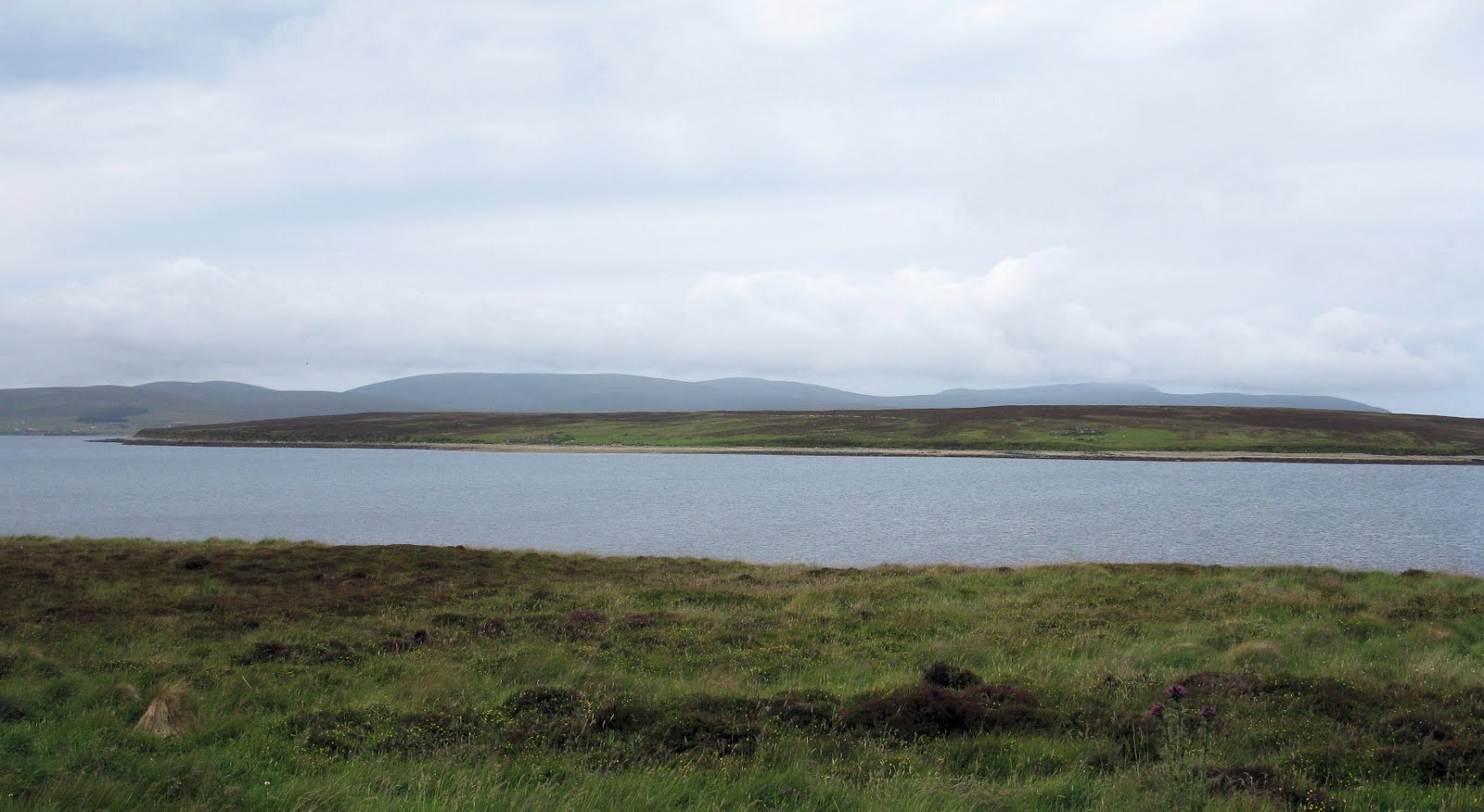
These are the views from the house we are staying in.


Liz has a little dog, Scotty.  He is quite a character and has quickly got us trained to attend to his every wish.  So we took him down to the beach for a walk - well we walked and Scotty had an evening snack of crab.


The number of different species of birds is astounding and the flowers and plants are glorious – this is just one of the varieties of wild orchid.


There is a local who enjoys making artistic installations from the bits of junk lying around – some left over from World War II when thousands were stationed on the island and the west hill was covered with huts.  This penguin family is one of his works.  Liz took us to see the West Hill are and the views were fabulous - again!  


Then we have the locals, and smiles and welcome from everyone. We enjoyed a lovely service at the Kirk when a male voice choir visited. The tea that followed was memorable. The next evening we joined Liz and some of the locals for an evening of making a very old Orkney child's toy – 2 limpet shells containing a little stone and the whole held together with felt. We also made little felt bowls by making felt around a stone. An evening of fun and laughter, outrageous jokes and another monumental tea. The ladies of Flotta are rightly famous for their cakes.


Monday, 27 June 2011

Travelling with my book

Time to write about The Fleece and Fiber Sourcebook (FFSB) which has become a constant companion.


The book weighs a lot – I think Deb's blog said it weighs over 3lb – so you need to remember that fact when reading about where I've been travelling with it. It needs to be that big and heavy because of the enormous amount of information it contains, the vast number of stunning photographs and the quality of the hardback binding. The latter being essential given how I'm carting it around and how many other people are looking at it.

There are a lot of threads about it on Ravelry, but one that was red hot at the end of May and beginning of June was in the UK Spinners group. Some of us had ordered our copies from Amazon at the beginning of the year and we were logging into our accounts daily to see when it would be arriving. Then Amazon did one of the most stupid things I've come across – they didn't rush through the orders. Do they not understand the significance of FFSB? Didn't the large number of pre-orders activate the 'put this book on rush order' button.

Well obviously not because they put back the projected delivery date – FAIL!

So we went hunting, and found that another company had the book listed under the original publication date of 1 June with deliveries estimated for a couple or so of days later.

Anyway I wasn't prepared to wait for Amazon's idea of 'urgent delivery of important book' timetable, so I put in a 2nd order with this other company. A few days later the book arrived – darling Husband was at home to receive it thank goodness. Can you imagine the anguish if it had disappeared into the Royal Mail/Parcel Force minimum 48hr wait for redelivery?

Feeling extremely angry with Amazon's cavalier treatment of sheep and wool enthusiasts I took great delight in cancelling my order with them and telling them why in no uncertain terms.

Back to FFSB – the cover is visually stunning. As you open the package the rust red colour starts showing and then you catch a glimpse of sheep and fiber – blissful anticipation.

Now at this point you'll be expecting me to relate how the rest of my life ground to a halt while I stayed up all night reading the book from cover to cover – I wish! Not only did I still have Jodi the Guide Dog puppy to look after and train, but life was incredibly busy – madly busy by any standards – with Woolsack and events related to that. The book sat by my laptop and I snatched quick random reads of it when I could. I also realised that in just the first few hours since it had arrived I had already used it as a reference book for a number of different sheep/wool related questions – and the book was not found wanting! It was easy to find what I was looking for in the index and the layout of the section on each breed made it easy to find the fact I wanted to check.

I prepared to travel to Peterborough for the East of England show where I was running the Woolsack stand. Book of course came with me and became a major attraction on the stand.


There were a few nervous moments when people from the other stands came over to borrow the book to show it to someone or check something out – would my precious book get safely back to me?


I was much happier with people reading it on the stand where I could keep an eye on it. If I'd taken a large crate-ful of the book with me we'd have sold the lot! Everyone liked it and the book itself stood up very well to this intensive handling.


Just a couple of days after getting back to Newcastle following East of England show and a Woolsack meeting with LOCOG at Canary Wharf the car was packed up yet again. Book was firmly in my hand luggage. Wherever I went the book came with me. All the way up the A9 and the cover to cover reading was at last able to commence in the hotel near Scrabster. Bliss.

 Inside and outside on the Scrabster to Stromness ferry


I hadn't realised how much general information about wool was at the front of the book. If you want a comprehensive explanation of Bradford counts, microns and measurements of wool fibres that are new to me, then this is the book you need. It also has a very handy and comprehensive chart putting all this information together – I wish the Flotta ferry timetable was as understandable!

The book was read at the ferry ports, on both ferrys, in the Stromness cafe and is now sitting happily by my bedside for reading at leisure during my week on Flotta.

In a Stromness cafe (Orkney cheese is delicious) and on the very windy final ferry to Flotta


This is a book that I would classify as essential reading for any spinner, but also has a great deal to offer knitters and weavers. Deb and Carol set out to try and source as many spun yarns as possible for the breeds in the book and they found many more than I had thought existed – very good news for those who don't spin. This time last year I was a non-spinning sheep and breed-specific wool enthusiast so I know what this book would have been able to offer me then.

Just before I left for Flotta someone raised, on Ravelry, the obvious question – would there be a FFSB group? This is actually a very natural evolution – why get all excited about something alone when you can share your excitement with other people. As we geared up to start a new group Beth from the Spinning Loft, who had kindly offered to start the group, posted the results of her 'existing groups on Ravelry' research – Blacker and Beyond appeared to have a huge overlap with the subject area of the book. After a poll, a number of posts and a check on the subject of whooshing entire threads into another group the decision was made. B&B would become B&B with FFSB and we'd give it a trial. Hasty changes were made to the group badge and banner – fortunately Deb came up with something much better for the banner than my rushed attempt – and the new part of B&B was launched.

Despite the fact that her daughter is getting married during the first weekend in June Beth started a Tour de Fleece FFSB Team. Let the fun begin!

So that's about it. I had thought I'd write a proper review of the book, but I realise it would have been very short. Not even I can pad out;

“Essential reference book, beautifully presented and bound, delightful and fascinating to read from cover to cover. If you are interested in sheep and wool, this is a 'must-have' book.”

So instead you've had the story of 'have book, will travel'.

The story is far from over..........

I'm flying to North Ronaldsay in a few days. I'm taking my sidekick wheel (Tour de Fleece starts the day we leave for North Ron) and hope to bring back some fleece. I really want to take the book. Total luggage allowance per person on the little plane is 15kg. Watch this space.

Thursday, 2 June 2011

Dear Husband, I've just bought a sheep

This was a conversation I had back in January of this year.  To be precise I'd 'adopted' a sheep, and to the relief of Dear Husband the sheep lives in Sweden so won't be coming to stay for a city holiday.  The response was fairly mild (he's used to stange things entering our lives via me by now) so encouraged, I adopted a 2nd sheep.  Yes, before you ask, we're still married and talking to each other.

It all started on Ravelry - someone posted in Blacker & Beyond that a flock of 70 sheep, including a number of rare Spelsau sheep, was in Sweden in Police custody awaiting slaughter having been neglected and underfed by their previous owner.  Some of the sheep had originally belonged to Renee Darley.  She posted about their plight on Ravelry and people responded.  Renee lives in a remote part of Sweden with enough land for the sheep and the experience to shepherd a flock of this size - all she had to do was deal with the Police and transport them 700 miles.  After which she had to house them during the Swedish winter, feed them and return them to good health.

The whole story of the flock and the rescue and fundraising is best read on Ravelry in the Sponsor a Spelsau Sheep group and the Longbacken group.  The great news is that the flock has now been rescued and enough money was raised to cover this.

This photograph shows some of the sheep when they first arrived at Longbacken - yes, some of them are very thin, but all survived the journey.


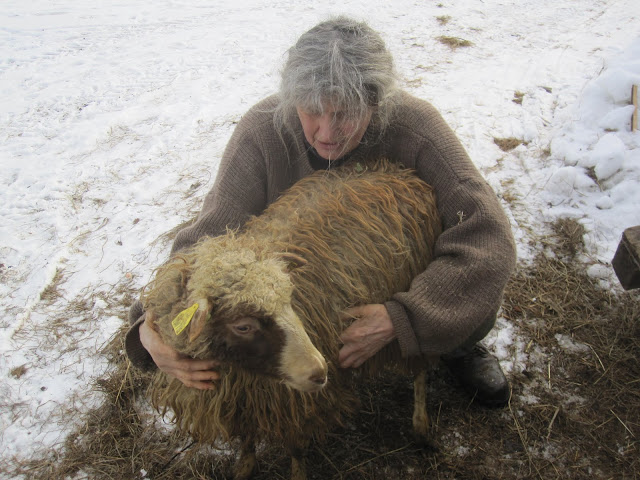
So, back to 'my' sheep.  It seemed obvious that they should become Blacker & Beyond group mascots.  This immediately gave us the name for the first sheep who is a rather magnificent 3 year old black ram.  He's 3/4 Jacob and 1/4 Wensleydale and has the 4 horns found in some Jacob sheep.  He just had to be called Blacker.  This is a photograph of him taken after he'd eaten his way through a mountain of hay.


Some of the sheep in the flock are a mixture of breeds, but having looked at a few of the north European breeds of sheep in the B&B Sheep of the Week I was very keen to adopt a Spelsau as well and Renee found me an absolute beauty.  She's a Spelsau gimmer and after a lot of thought and consulting lists of Nordic girls names we chose Dagrún.  The D and the R in the name aren't a coincidence.  We wanted to link her name to Deb Robson because the whole Blacker & Beyond group was started during a workshop Deb led in the UK last year.  The participants came from 3 different continents and we wanted to continue sharing our enthusiasm for breed-specific yarns and fibres and sheep on Ravelry.

So this is the beautiful Dagrún.


It doesn't stop there.  If Dear Husband had managed to remain calm while I adopted 2 sheep, he was bound to notice if my fleece/fluff stash grew with Blacker and Dagrún's fleeces.  Plus I wanted to find a way the group could share the fleece from our mascots.  That's where the link with p/hop comes in.  P/hop stands for 'pennies per hour of pleasure' and is a fundraiser for Médecins Sans Frontières.  So if you enjoy knitting something, especially if you use one of their donated patterns, then you make a donation to reflect this.  An international charity for an international group.

So the fleece from Blacker & Dagrún will be going round the world to group members who want to spin it or felt it and make a donation to p/hop.  The quality of this year's fleece is obviously going to reflect the ordeal the sheep have been through, but we're looking forward to next year when the sheep will all have settled in and be in tip top condition under Renee's experienced care.

So we now have this on our group front page:


There is of course more.  The flock had a number of rams in it and although it was thought that most of the ewes were in too poor a condition to have carried lambs they defied their ordeal and started giving birth - mostly to little boys!  An alarming number of lambs came out looking like their father - Blacker.  It is now a running joke in the Save A Spelsau Sheep group.  He has a lot of good qualities that Renee would like to pass on as she improves and develops her Spelsau and spinners' flock, but he won't be allowed the same freedom this coming autumn as he had the last.

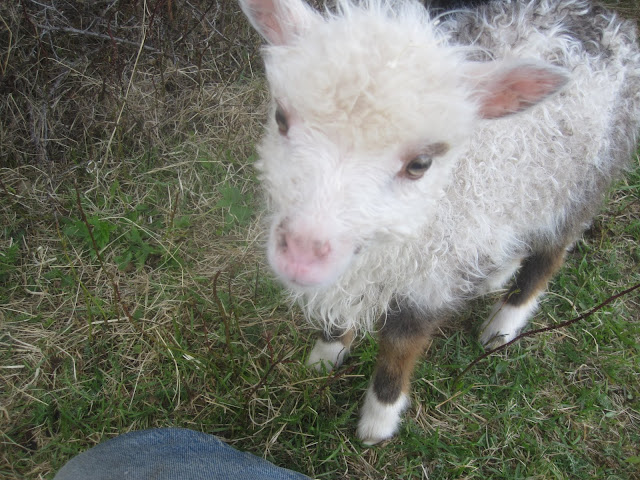
The Spelsau ewes seemed to lamb later than the other breeds and I think we all thought Dagrún was too young, but she surprised everyone by giving birth to a little gimmer (female) lamb.  The lamb has been adopted by another member of the B&B group and we're just waiting to hear her name.  She is as beautiful, if not more so, than her mother and I'm delighted to say that this time Blacker is not the father!


 More photos of the B&B trio can be found in this thread on Ravelry and anyone who enjoys spinning and fresh air in Sweden should have a look at Renee's website and see what she has on offer.