Showing posts with label spinning. Show all posts

Friday, 1 July 2011

Adventures with Lace

The two main things I told Liz that I'd like to work on during the week were learning to spin lace and to go further with knitting lace.  Now when I said this what I had in mind was lace weight yarn.  So it was a bit of a shock when Liz produced some cones of very nice ColourMart cashmere that was rather thinner - in fact it was cobweb weight.

However the shock was lessened by Liz's reassurance and the fact that I got to try a little sample first:


This is really thin stuff.  Next step, to make a small triangular shawl using a construction technique that involved knitting the centre triangle first, then picking up around 2 edges for the border and finally knitting a lace edging which would be knitted sideways along the edge of the border and joining by knitting in the edge stitches as the edging progressed.  It all sounded very complicated and this was what had put me off trying a shawl with any of these elements before.

Still, with Liz there to help I was up for the challenge and learning how to do all the techniques involved.  I'm not the fastest knitter though so it came back with me for evening 'homework', even if in practice this meant doing it in the morning before breakfast - memories of cramming on the bus to school!


Slowly the knitting progressed and grew.  First the centre triangle was finished, and then as I got more used to the yarn and reading from the charts the border and edging followed.  Lots of extra tips from Liz along the way which will really help me when I tackle a full size version in the future.

  The really clever thing was that in all of the moving from different sections I didn't need to break off the yarn once, it all just carried on through.  Finally this morning I finished and blocked the shawl which dried very quickly outside in the sun and wind so reveal the finished shawl - soft, gorgeous, feather light, and I can't wait to start a larger piece.


So that was the knitting side of my week.
At the very start of the week Liz had introduced us to the fun of dyeing yarn and fibre - a great way to break the ice and I really enjoyed myself.  I've not done much dying of fabric since I graduated in 2003, so it was really good to get back into the fun of creating with colour at the level of fleece and yarn.

Here are a couple of my experiments.


The green and pink fibre, once dry, I started spinning as fine as I could go, and was pretty pleased with this first attempt.


Then Liz started teaching me about how to knit lace weight and the need for good fibre preparation with a lot more twist in the spinning.  I combed the dyed fleece which was absolutely gorgeous - very fine lustrous Shetland.  I didn't realised that Shetland could have such lustre.

  Then came the spinning and I was thrilled with the results - a finer and more even yarn than I'd dreamed I could spin.


Before I knew it I'd spun all the dyed fleece so Liz went into her shed and came out with the most divine Shetland fleece I'd seen - and it was huge!  Gorgeous shades of grey and fawn.  Perfect to ply with the green and pink I'd already spun and a bag of it is tucked away to finish this project at home.


Then Jeannie came down the hill and into my life and the lace spinning got really exciting.  In just a couple of hours I progressed from this:

 to this - which is shown alongside the ColourMart cobweb for comparison - yes, Liz had not only got me knitting with cobweb, but spinning it as well.  I was over the moon!


Then to finish off today, my last day working with Liz on Flotta, she came up with something rather special, and initially very scary - qiviut.  Totally divine even in the raw state here, and if you can see past the not very good photo, you'll see how beautifully and finely it spun up. 


Tuesday, 28 June 2011

Love Affair on Flotta

The day started quite normally.  Anita and I started knitting with some cobweb lace in the morning and with Liz's help got on very well adjusting to this very thin yarn.  We're doing one of Liz's small lace shawls so when we've finished the centre triangle we can learn how to add on the lace borders and pick up stitches sideways as we knit - I think that's the process.

Then after a lovely lunch with yet another variety of home made soup (I may have to let out my belt as the week goes on with all this gorgeous food being cooked for us) Liz said we could go with her to visit Granville Swanney who lives a bit up the hill.  Liz explained that he is the only person left on Orkney who is still making spinning wheels.  Not any old wheels mind you, but traditional Orkney wheels.  This little outing seemed interesting enough that the men came along with us.  We are very fortunate at home in having a very talented cabinet maker, Stephen Robinson Gay living in Northumberland and we live with some of his wonderful work in our home, so Paul was particularly interested to see the work of another talented wood craftsman.

I was delighted to find that Granville and his wife Jean have a retired Guide Dog living with them so that was an extra treat meeting him.  Then on into Granville's workroom - what a sight.  It's one of those workrooms where everything has its place.  There were some pieces of turned and polished mahogany lying on the bench and in a flash Granville had assembled them to reveal a nearly finished wheel.


I wasn't at all surprised to hear that it takes 60 hours to make one of these beautiful wheels.  Liz explained what features in combination made this an Orkney wheel and it was a fascinating time in the workroom.

Then we went on into the house where Liz found a wheel in the corner.  We learnt that this was a sloping bed Orkney wheel that had never been used since Granville finished making it.  A tiny bit of fibre was found and Liz managed to attach that to the spindle and start spinning - well, the noise!  Some oil was urgently needed.  Next thing I knew Liz invited me to sit down and have a try while she went back home to get some oil and more spinning fibre.

Now I'd already decided that I prefer double treadles and I definitely like scotch tension - double drive sounds much too complicated and difficult to adjust to me.  But if Liz said to give it a try - well I was sure that I'd receive confirmation of my feelings about double drive traditional wheels.  So I sat down at this new, creaky, wheel that ticked every box for what I didn't want in a spinning wheel. Needless to say I spent the next few minutes with the thread breaking every time I touched it.

Then something totally unexpected happened - and I still don't know what.  Suddenly, despite the noise, the wheel and I connected and I experienced the wonderful character that had awakened in the wheel.  Equally suddenly I was spinning beautiful laceweight yarn with no effort or thought.


I've never wanted to name any of my other wheels - but I was already wanting to give this wheel a name - despite the fact that she belonged to Granville or had already been sold to someone else.  That was a very strange experience for me.

Then Liz arrived and the oiling started.  Within a minute or two the wheel became smoother and quieter and I started working through the lovely Shetland top Liz had bought.  She was still singing to me though - just a happier and quieter song.


Then it came time to leave.  I didn't know where in the world this beautiful wheel was destined to be sent.  I'd felt very privileged to be the one spinning when Granville's craftsmanship was brought to life, but very sad to be leaving her.

It ended up with Paul and I walking back while the others came in the car and Paul must have sensed what I felt about this wheel because he brought up the subject.  I had absolutely no idea what the wheel would cost or if she was even for sale.  For all I knew there was a long waiting list and this wheel already had an owner.  Paul suggested that we have a chat with Liz.  Earlier this afternoon Liz phoned Granville and came back with the wonderful news that the wheel was for sale and we immediately said 'yes, please'!

So, when we leave Flotta, Jeannie will be coming with us.  I really wanted to give her a name that had a link to her roots here on Flotta and Granville's wife is Jean, so the name was as obvious as my feeling that this was 'my' wheel.

So, that is the story of my extremely unexpected and surprising encounter today.  I'm still in shock a bit - I'm really not used to this sort of thing happening, but in the house up the hill Jeannie is soaking up her oil and waiting to sing and spin with me again.  I'm very happy.


Thursday, 13 January 2011

Spinning carried over the New Year

The title of this post refers not so much to what I've been spinning over the New Year period, but to the fact that I have some photos of spinning and an old spinning wheel I'd taken way back in September and the planned blog post kept getting postponed.  So in the best traditions of tidying things up to start a new year, I've finally put down the luscious bit of lace knitting I'm doing at the moment and have sorted out those photographs.

To be absolutely honest there has also been the imperative of realising that a fascinating article in issue 34 of  Yarn Forward Magazine, which includes the photograph of my Grandma and some of her siblings from an earlier post (Musings from my spinning wheel), also includes the url for this blog.  Sudden realisation - I hadn't posted for a few weeks!

So here at last are some photographs from 2010 of an old wheel and a spinner in Tudor dress at Hardwick Hall.
I was really interested to see the wheel in one of the rooms in  Pockerley Manor at Beamish Museum.  Pockerley Manor illustrates the life of a yeoman farming family in the early 1800s, so I presume that this wheel dates from that period.

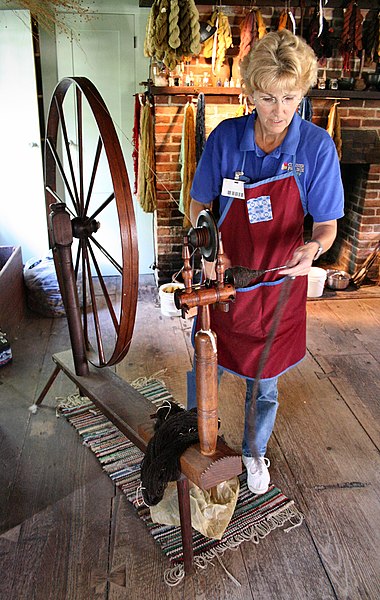
The first thing I noticed is that the wheel is very large and doesn't have a treadle.  In fact it looks as if it may have been made by someone who made cart or carriage wheels.  I was rather perplexed about how this wheel could be used until I found a couple of groups on Ravelry - Antique Spinning Wheels and Longdraw Spinners.

My original thoughts that the wheel would be turned by a child, have now been replaced by learning of  the impressive feat whereby the spinner manages both the drafting and wheel turning herself while standing.
This photograph from Wikipedia shows  a Spinning wheel demonstration, producing yarn from wool, at Conner Prairie living history museum in Fishers, Indiana.
Photo shot by Derek Jensen (Tysto), 2005-September-03

Now while I can see that her right arm could be used to turn the wheel, I'd seen in a modern copy of the book, The Luttrell Psalter, a very different position used by the spinner.
 This link shows the image from the original Psalter, dated 1300-1340,
 and this link shows an image from a film made of the Psalter and most clearly and beautifully demonstrates how this sort of wheel was used. (scroll down to below the ploughing)

What I find most interesting is that the wheel itself, to my amateur eyes, appears very similar to that in Pockerley Manor, although there are are 500 years between them.

The Psalter also shows a woman carding, again in a manner very similar to how it is done today and using carders that look as if they could have been purchased today.

These two further photographs from Pockerley show some of the tools associated with spinning.  On the dresser at the back of the right hand photograph is a niddy noddy and lazy kate, again looking very similar to modern versions.


To have a glimpse back into Tudor times, the day I visited Hardwick Hall last September, they had re-enactors  in the hall, including a lady from the local  spinning Guild who was dressed in Tudor dress.


Although her wheel and spinning equipment aren't Tudor, those of you with sharp eyes will have spotted that the wheel is a little unusual.  From what I remember she said about it, and it was lovely having a chat with her, the wheel was 'rescued' at Chesterfield Market and restored.  She thought it was possibly continental in origin.  The wheel has two flyers and is called a Gossip Wheel, although whether it was really able to be used by two spinners I don't know.

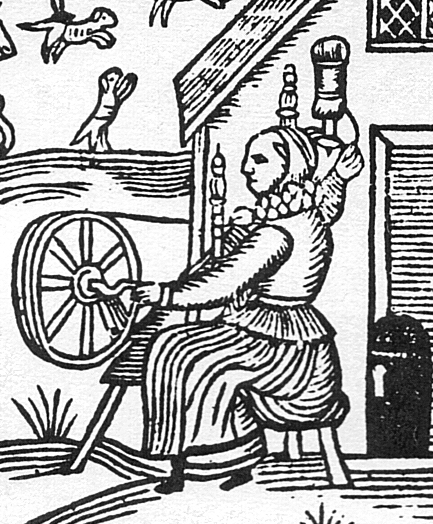
While reading the article in Wikipedia I also found this delightful woodcut image from the early 17th century.  It looks as if she is turning the wheel using a little handle, but also has a distaff and is using a longdraw method.

 This public domain image from Wikipedia is scanned from Horizon Book of the Elizabethan World by Lacey Baldwin Smith, New York: American Heritage Publishing, 1967
Although I am very much a beginner in learning about the history of spinning and spinning wheels (not to forget spindles), what I do know is that certainly before the 1800's, and possibly into the 19th century, my female ancestors would probably all have spun yarn, and for many of those centuries it would have been wool.  English wool - the backbone and driving force of the medieval English economy.

I know that the 3 generations of women before me did not spin, but on my maternal side my great great grandmother, Sarah Armstrong, born in Northumberland at the beginning of the 19th century, may well have spun.  She was the daughter of a farmer, grand daughter of a Shepherd, and she married a farmer who had generations of Northumberland tenant farmers behind him. 

I don't really do New Year resolutions, but one thing that is definitely on my To Do list for this year is to relate what I've discovered about her life, and to see if there is any connection other than geographical with the Blue Faced Leicester sheep.

I'll also do a fuller post about Margaret Jane Walker, the woman who almost certainly knitted the dress in the Yarn Forward article.  Her large family alone tells the story of the early part of the 20th century and were affected by nearly every significant event of that period.

Monday, 22 November 2010

Sheep to sweater - the beginners version

During August, the same week that I started spinning and had my love of breed specific yarn and  fleece raised to new heights, I was able to observe a Sheep to Sweater challenge.  The concept was wonderful and totally intriguing, but for me it was very much something to observe rather than ever contemplate doing.  Well, to be honest, it still is, but I've just had my own beginners mini version and I'd like to share how totally chuffed I feel about the whole thing.

 In one sense it started with an impulse buy at The Knit Studio in Newcastle a couple of weeks ago.  Despite having enough fleece stacked up in pillow cases to consider insulating the house, this little plait of Shetland tops below found it's way into my bag

This image shows the label.  The reason for the photo having been taken while it was draped over the spinning wheel will be explained.


I just fell in love with the colours, although I had no idea how it would spin up.  However with it being Shetland I had confidence that I could spin it.  I've come to have a great respect, as a beginner, for Shetland fleece, which is proving to be most forgiving and to do its best to spin beautifully regardless of what new technique I'm trying or how irregular my drafting and twist is.  

While I'm singing the praises of Shetland I should add that my love affair with it started when I began doing Fair Isle knitting and steeking.  Shetland is a yarn that was created to do lots of friendly things when 2 colours are knitted together and that behaves impeccably when steeked.  One swift cut of the yarn and the cut edges just curl back nicely and give a little reassuring cling to the reverse side of the fabric, removing any horrific nightmares of hours of knitting unravelling.

So my pretty little plait came home with me and entered the realms of what I've learnt through Ravelry to call my 'Stash'.   I now have a yarn stash and a fleece/fibre stash.  The former is actually fairly modest by some standards since I had a big clear out and found new homes for a lot of yarn that I knew I wouldn't knit up this side of the mid century.  The latter is big in volume, but does have the benefit of insulating the room it is stacked up in.  I do however have a number of whole raw fleeces and distinct memories of some lovely people who know a lot more about fleece than I do telling me that it can't be kept forever in its present state and that some processing should be done before Christmas.  That's this Christmas - the one just a few weeks away.  Say no more.

The pretty little plait might well have remained in my 'admire and fondle' pile if it weren't for a little knit along challenge that was proposed on one of the Ravelry groups I'm in.  The challenge was to pick something small and quick to knit, post photos of the yarn, pattern and everything needed to complete it by Friday night and then to finish it by Sunday night.  What a lovely idea, and reading through the thread, lots of people also thought this was a good idea and lots of photos of patterns for knitted penguins and other small items appeared.  I should add that this is a group entirely moderated by penguins, but it is one of the British groups on an American heavy site, and one thing Brits are good at doing is chatting (lots) and being delightfully eccentric.

My personal challenge was that I would be spending most of Saturday at Tynedale WSD Guild spinning.  I'd organised puppy sitting and was really looking forward to a day of spinning with lots of lovely experts on hand to answer my innumerable queries.  Plus Tynedale does awesome shared lunches - I mean this is a Guild that takes the concept of a communal lunch to a whole new level.  Then I thought about my pretty little plait, and came up with the 'clever' thought that I could spin this plait on the Saturday and knit a head band to keep my ears warm when wearing my cycle helmet.

Now all experienced spinners out there will have seen the size of the plait, be aware of my novice spinning skills, and will be experiencing some amusement at my plan to 'spin' the whole plait in one day.  They will also have thought ahead to the little steps (ok, not so little) that I've forgotten about that come between spinning and knitting.  Things like plying, skeining, washing, drying, winding.  The bits of my very nice beginning spinning book that I hadn't really got to yet.

So, I take my photo of the pretty little plait with the equipment I'd need to turn it into a headband.  The multiple needles are because I wasn't sure how thick the yarn would be, so I didn't know what size I'd end up using.  I load up the car, not forgetting the essential contribution to lunch and swan off for a day of puppyless freedom away from the house with its constant reminders that housework fairies no longer exist and ironing bags can multiply overnight.  

I must add, as Christmas is so close, that when I was recently having a frantic search for my Beloved's black concert shirt, that I came across all the Christmas table linen still un-ironed from last year.  No doubt it will remain lurking menacingly at the bottom of one of the ironing bags until Christmas Eve, although that does have the benefit that it can go straight from ironing board onto the table, missing out the folding and getting creased bit that most people put in the middle at some point during the year.

Dear future descendants, it would be impossible for me to hide the fact that housewifely tasks do not feature high up my list of priorities, and most photos you may find of the interior of the house have been carefully staged, sometimes involving that time honoured process known as "bung it behind the sofa".  This is a skill that some people, including myself, have acquired over years of practice, resulting in the ability to 'clear' a room in less than the time it would be polite to keep an unannounced guest standing on the doorstep.
I have a large sofa!

Anyway, back to Saturday and the Guild.  Lovely people that they are, any hysterical laughter concerning my weekend plans was carried out where I couldn't hear it.  There was a little mention of the word, brave.  This was from someone who has years of spinning behind her and can actually plan what thickness she wants to end up with and knows what ratios are.  But it is a lovely Guild, so I also got some essential tips to help me on my way.  I'd thought that I needed to let my spun singles rest before plying.  I was told this wasn't essential, but that washing the yarn between plying and knitting was important and would make a difference.  I realised that my original plan to spin for a day and a bit, spend 5 minutes plying and then whip up the head band in a couple of leisurely hours on the Sunday afternoon (that I have done before - headband in the round is a quick little knit) would need some serious adjustment.
In order to get the yarn dry after washing I would need to do all the spinning and plying before going to bed on Saturday night.  Right!

I got about half the pretty little plait (seemingly growing in size throughout the day I should add!) spun at Guild, aided by the fact that everyone very sensibly spun during the AGM.  I do like a group of people that share my priorities.  I'd forgotten to take my camera, but was able to find it when I got back.  Tea became DIY meal - fortunately my Beloved is used to this concept by now and just got on with it.

So this is what happened during the next few hours:

 I spun the tops onto 2 bobbins to make plying easier.  Oh I should add a bit of technical stuff here - I was after speed as much as anything so opted for a long backwards draw and was aiming for a finished plied yarn of about 4ply thickness (fingering to anyone reading this who lives the other side of the pond).  A bit of judicious weighing of the plait helped me to get equal amounts of weight of yarn onto each spool.  I also pull off quite short bits of bits of tops, pull them apart from the end to loosen up the scales, (I think the term Rolag is coming in somewhere here) and then fold it over my index finger and spin woolen from the end of the folded bit.  I'm quite sure there is a far more elegant and concise way of describing this, but anyway, it's a way that works for me.

What had quickly become apparent during the day was the very pretty colours the painted tops were producing when spun.  The yarn half filled the bobbins, so I was hoping that when plied it would all squeeze onto one bobbin.

To speed up the spinning and slow down the speed of my treadling I moved the drive band onto the next groove down on the bobbin, although this did make treadling harder work as the bobbin filled up.  Oh, and I have an intermittent squeak - a clunking sort of squeak.  I think it's related to the way my poor wheel get dragged around, carried through the centre of Stocksfield, and bangs around a bit in the back of  the car.  I can see why people end up with more than one wheel and why their collection includes a travelling wheel.


Now it will be obvious from the photographs that by this time it was dark outside.  In fact, by this time we were well into the 'wee small hours'.  If I was going to achieve this challenge then the yarn had to be washed before I went to bed so it could dry 'overnight' - well have a few hours at least to dry.  Overnight was by now becoming a rather more reduced concept than usual.


Finally, about 2am, the plying was finished and as you can see above it just squeezed onto the one bobbin.  It had taken me considerably longer than the 5 minutes I'd visualised.  I don't know why I have an image in my mind of plying being something really really quick. 

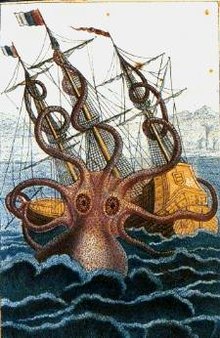
Last time I'd done it I'd ended up in a dreadful tangle with the singles wrapping round each other and themselves and anything else that came in their reach - it had been like having an overexcited Kraken at my feet.

Fortunately I got some essential tips on the correct use of a Lazy Kate from people at the Guild, and it did make a real difference with the tangling issue.  It still took a very very long time though.

The next stage was the Niddy Noddy.  Mine was quickly assembled and the niddying or noddying commenced.  By this time Jodi (the Guide Dog puppy, now 8 mths old) had realised that there was still someone up and about so she came into the front room to investigate.

My Niddy Noddy gives a full wrap of 1.5m, so a quick count of the number of wrappings, 150, told me I had 225m of yarn.  At this stage it was still looking sort of like 4ply thickness, although it's most frustrating when the 2 singles being plied together have either their thickest or their thinnest bits coinciding, rather than nicely cancelling each other out.
Anyone who knows dogs will recognise the expression on Jodi's face.  What she really wants to do is have a good investigation of this exciting thing that has been waved in front of her face for several minutes, but she has just been told to "Leave It", and is not impressed.

Whizzing on through the next bit which involved some figure of 8 tying of the skein (or is it hank?) so that it would all stay together nicely during the washing and drying and not do Kraken things in my sink.  I then realised that 'washing', according to the book, meant 'soaking for 20 minutes' in warm water with a bit of washing liquid added.  20 minutes at that time in the early hours is a very long time!  It did give me time to assemble the towels for drying/squeezing and the hanger to hand up the hank/skein - I know one is the untwisted and one the twisted, but I can't remember which way round just at the moment.  But anyway, you know what I mean.  After the soaking and realising that this miraculous 'blooming' was occuring, then a quick rinse in clear water with a dash of white vinegar (yet another use for white vinegar) and then a final rinse in clear water before the pressing with a towel.  Then, just about the time when the dawn chorus would have been starting if it had been summer, the hank was hung up on a coat hanger to dry 'over night'.

Needless to say I was not up bright eyed and bushy tailed at  my usual 6am the next morning - I wasn't anything at 6am other than comatose, and finally crawled out of bed just in time to grab Jodi (fortunately my Beloved had done the essential feeding of the ravenous hound at her usual time) and dash to Church with her - being Family Service it meant I could combine Church and her training trip into one.  I did actually make time to check the yarn - unsurprisingly it was not completely dry.  No fear, I was sure I'd heard someone at Guild mutter something about radiators, so the yarn was flung onto a radiator to dry while I was out.


Now anyone who has actually read all of this may have some recollection of the time I knew it would take to knit a cycling headband, and be wondering why the rush at this stage.  By now I'd reached the stage of having a finished yarn, so a leisurely afternoon of knitting should be all that was left.

The trouble is, as you can see from this photo, I'd ended up with a very beautiful looking yarn.  Even with the novice hand spun look of the structure of it, this was to me a very pretty yarn indeed.  Much too pretty in fact to end up hidden by a cycling helmet.  I also had a whole 225m or so of this lovely yarn.  There was only one reasonable solution.  I had to knit myself a proper hat.

Now I'm not the fastest of knitters so I knew from experience that even knitting a plain hat would take several hours.  I also thought it would be a good idea to knit a swatch to see what thickness of yarn I'd ended up with.  It looked, on average, like something between a 4ply and DK, but my attempt to use a WPI tool had failed miserably.  Even trying it on commercial yarns of known thickness had failed to give me a figure that matched the information on Ravelry for those yarns.  I obviously need to do a class on how to measure WPI.  

First though I needed to wind the hank into what I understand is called a 'cake'.  I used to wind what are commonly know as balls, but they do tend to skitter about rather a lot when knitting with them, and skittering and balls mixed with puppies ends in tears - always, without fail.  Fortunately I'd been taught to wind a centre pull 'cake' on my thumb (thank you Annie), so this was a fairly straightforward operation, all the more so since I'd acquired a swift and released my Beloved from the hank holding task.  Difficult to hide exciting little impulse purchases of yarn from others if someone else has to hold it for you for winding.  Anyone with a guilty stash needs a swift.


Swatching was more successful though - I should add that I was cooking Sunday lunch through all this - my Beloved was a little uncomprehending about what I was up to and why I was rushing around and staying up to Silly O'Clock, so I felt one of my roast lunches was called for at this point to deflect him from the important activity of the weekend.

Anyway, I ended up with finding that 4mm needles gave a lovely feel to the knitted fabric and it gave me a gauge of 22 stitches to 10cm.  Equipped with that information I hit the Ravelry pattern search and found a top down plain hat that promised to offer what I was looking for.  Heads are Round from the top down seemed to be what I needed.

Finally, after lunch, I was able to start knitting.  A slow start when I realised I needed to look up a figure of 8, or magic cast on, but eventually I found instructions I could comprehend in my sleep deprived state and the knitting commenced.  I should add that lunch had been a bit delayed, so it wasn't until about 4pm when I actually started knitting.  I had considered trying out my new and still unpractised continental knitting skills, since this can be a quicker way of knitting, but I decided the possibilities for a tension disaster or late evening frustration was too great, so I stuck with the familiar but slow.

It was actually pretty miraculous and wonderful actually knitting up something I'd spun myself.  It didn't all fall apart in my hands, and even better, the inconsistencies in the yarn seemed to hide themselves in the knitted fabric, just leaving that 'handspun' look about the fabric.  It was going so well that I decided, after the increasing and shaping had finished, to include a little patterned border before the ribbing.  Obviously by this time tiredness was influencing my judgement.  At about 11pm on the Sunday evening I posted this image into the challenge thread.  Fortunately there were still some Banterers around and I got some lovely encouraging replies to my decision to tough it out and keep knitting to finish it before I went to bed.  That was the challenge - not to finish on the stroke of midnight - just to finish before going to bed.


Finally at about 2.30am it was finished.  My hands ached, but it fitted, it looked gorgeous, felt amazingly warm, and I even had a little bit of yarn left over.  Knitting top down had been tricky to start, but it had saved me hours of 'will there be enough yarn' worry.  I knew that if I had run out, that using a different yarn for the turn up or brim could have been made to work.  Happily though that wasn't necessary.  As per the 'rules' of the challenge I posted the photo of the finished hat and crept off to bed.  It was so worth it though, and has given me a new perspective on what can be achieved with spinning.  So that's it, I've done it, I've taken a fibre you could tear up easily and scatter to the wind and made it into a beautiful, functional item.
WOW - right chuffed. ☺

Thursday, 19 August 2010

Spinning - a really exciting event in my life captured in photographs

So you're one of my descendants checking out Great Grandma, or you've happened across this blog and seen it's about knitting and my female ancestors and what do you get - a first post about a difficult period in MY life, and then .......Spinning.

I'd better explain.  Last week I was in Stirling at the very first UK Knit Camp - hopefully the first of many.  Had a totally amazing, stimulating experience learning new skills, meeting lots of wonderful people from all round the world, turning an interest in rare and specific breed fibres into a passion, and taking my first steps into the world of spinning.

I had an afternoon in a beginners spinning class with Deb Robson.  Between the frequent yarn breakages and production of yarn thick enough to make a rope of, there were some very brief but peacefully ecstatic moments when it all came together.   I came home from Knit Camp with 4 fleeces in my car and the details of where to purchase my first wheel.  Choosing which wheel to get had been more straightforward than I'd anticipated.  There were a lot of experienced spinners around who were only too happy to talk wheels and I got to try a few.  One name kept cropping up, and when I tried one of them I knew this was the one for me.

First thing Monday the order was placed and then yesterday I got the phone call to say it would be arriving today.  Which is one reason why I was up to silly o'clock last night/this morning setting up and starting my blog, because I knew once the wheel arrived then the blog-birth might be postponed indefinitely.

Then, just before lunchtime this arrived.


The box, not the dog - she's a puppy spending her first year living with us.  This is a very perceptive puppy and the look on her face shows that she has sensed the enormity of the contents of the box, and is perhaps a tad apprehensive about the implications for her.

Husband was around - he'd been on 'post watch' while I did the morning training session with the puppy.  He seemed relieved when I said I'd take the wheel into the front room and assemble it by myself as part of the 'getting totally acquainted' process.  In fact so relieved that he went and sorted out all the tools the instruction leaflet told me I'd need.  I think he has some traumatic memories himself of 'us' with a box of bits from MFI or Ikea and an instruction leaflet that was either missing or written in Martian.


He needn't have feared - this was an Ashford Traditional Wheel from New Zealand, where they obviously have quite a different attitude towards instruction leaflets.  The diagrammatic instructions were actually clear and precise, and just before I got to the tricky bit I found there were also written instructions, in English (that's proper English, not translated from Chinese by a 5 yr old who can only speak Portuguese) that made things even clearer.


There was a bit towards the end that involved a bit of strength with a screwdriver, so I invited him into the front room and he agreed to demonstrate his superior muscle strength and prowess with a screwdriver - which he did beautifully, but he did prefer me to do the 'banging the pin into the crank hole with a hammer' bit, so that if the hammer slipped he wouldn't have to spend the rest of his life knowing that I had to look at the 'dent made by husband' in my wheel every time I used it.  He even managed a modicum of sincerity when I asked him if he didn't feel that the atmosphere in the front room was unusually calm for this sort of construction situation.


I should explain that some of my past encounters with putting things together have been exceedingly fraught and traumatic, so his caution is actually quite sensible.  Anyway, we ended up with a wheel that looked like the one I'd tried at Knit Camp, it's still daylight outside, and most importantly - there are no bits left over!


Puppy managed to slip back into the front room once the 'yet to be named' wheel was completed and decided to pose for the final triumphant photograph.