Tuesday, 28 June 2011

Love Affair on Flotta

The day started quite normally.  Anita and I started knitting with some cobweb lace in the morning and with Liz's help got on very well adjusting to this very thin yarn.  We're doing one of Liz's small lace shawls so when we've finished the centre triangle we can learn how to add on the lace borders and pick up stitches sideways as we knit - I think that's the process.

Then after a lovely lunch with yet another variety of home made soup (I may have to let out my belt as the week goes on with all this gorgeous food being cooked for us) Liz said we could go with her to visit Granville Swanney who lives a bit up the hill.  Liz explained that he is the only person left on Orkney who is still making spinning wheels.  Not any old wheels mind you, but traditional Orkney wheels.  This little outing seemed interesting enough that the men came along with us.  We are very fortunate at home in having a very talented cabinet maker, Stephen Robinson Gay living in Northumberland and we live with some of his wonderful work in our home, so Paul was particularly interested to see the work of another talented wood craftsman.

I was delighted to find that Granville and his wife Jean have a retired Guide Dog living with them so that was an extra treat meeting him.  Then on into Granville's workroom - what a sight.  It's one of those workrooms where everything has its place.  There were some pieces of turned and polished mahogany lying on the bench and in a flash Granville had assembled them to reveal a nearly finished wheel.


I wasn't at all surprised to hear that it takes 60 hours to make one of these beautiful wheels.  Liz explained what features in combination made this an Orkney wheel and it was a fascinating time in the workroom.

Then we went on into the house where Liz found a wheel in the corner.  We learnt that this was a sloping bed Orkney wheel that had never been used since Granville finished making it.  A tiny bit of fibre was found and Liz managed to attach that to the spindle and start spinning - well, the noise!  Some oil was urgently needed.  Next thing I knew Liz invited me to sit down and have a try while she went back home to get some oil and more spinning fibre.

Now I'd already decided that I prefer double treadles and I definitely like scotch tension - double drive sounds much too complicated and difficult to adjust to me.  But if Liz said to give it a try - well I was sure that I'd receive confirmation of my feelings about double drive traditional wheels.  So I sat down at this new, creaky, wheel that ticked every box for what I didn't want in a spinning wheel. Needless to say I spent the next few minutes with the thread breaking every time I touched it.

Then something totally unexpected happened - and I still don't know what.  Suddenly, despite the noise, the wheel and I connected and I experienced the wonderful character that had awakened in the wheel.  Equally suddenly I was spinning beautiful laceweight yarn with no effort or thought.


I've never wanted to name any of my other wheels - but I was already wanting to give this wheel a name - despite the fact that she belonged to Granville or had already been sold to someone else.  That was a very strange experience for me.

Then Liz arrived and the oiling started.  Within a minute or two the wheel became smoother and quieter and I started working through the lovely Shetland top Liz had bought.  She was still singing to me though - just a happier and quieter song.


Then it came time to leave.  I didn't know where in the world this beautiful wheel was destined to be sent.  I'd felt very privileged to be the one spinning when Granville's craftsmanship was brought to life, but very sad to be leaving her.

It ended up with Paul and I walking back while the others came in the car and Paul must have sensed what I felt about this wheel because he brought up the subject.  I had absolutely no idea what the wheel would cost or if she was even for sale.  For all I knew there was a long waiting list and this wheel already had an owner.  Paul suggested that we have a chat with Liz.  Earlier this afternoon Liz phoned Granville and came back with the wonderful news that the wheel was for sale and we immediately said 'yes, please'!

So, when we leave Flotta, Jeannie will be coming with us.  I really wanted to give her a name that had a link to her roots here on Flotta and Granville's wife is Jean, so the name was as obvious as my feeling that this was 'my' wheel.

So, that is the story of my extremely unexpected and surprising encounter today.  I'm still in shock a bit - I'm really not used to this sort of thing happening, but in the house up the hill Jeannie is soaking up her oil and waiting to sing and spin with me again.  I'm very happy.


Life on Flotta - 1

So what is life like on a small Orkney island, about 3.4 sq miles and with a population of about 70?

Here in June we have noticed the exceedingly short night and the near-constant wind.  In the winter we've been told this turns into near-constant gales with occasional days when it is unsafe to venture out lest you be blown away.  We've had rain and grey days, but at the moment the sun is shining and the sea is blue.  The air is clear and the lichens are glorious in their abundance.
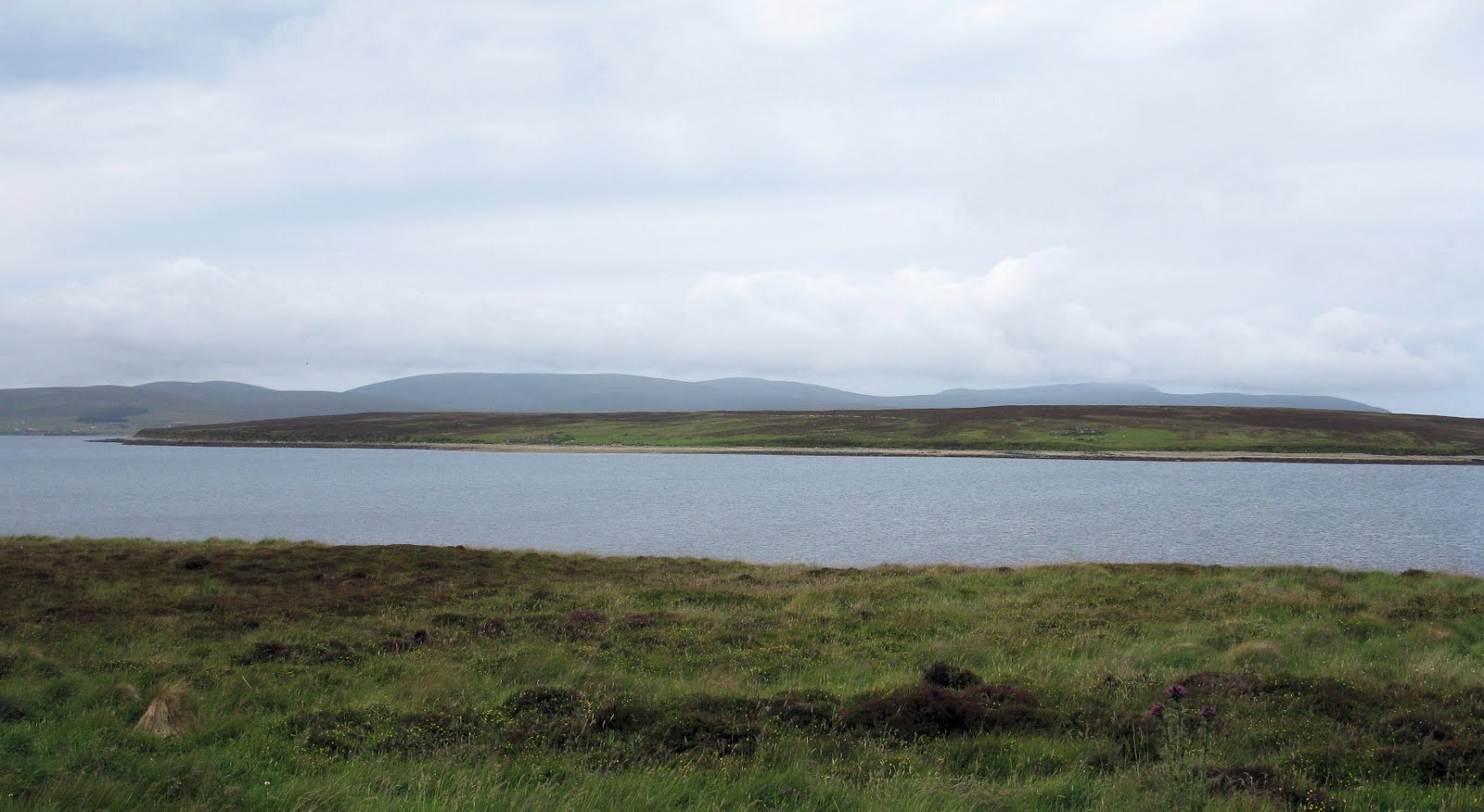
These are the views from the house we are staying in.


Liz has a little dog, Scotty.  He is quite a character and has quickly got us trained to attend to his every wish.  So we took him down to the beach for a walk - well we walked and Scotty had an evening snack of crab.


The number of different species of birds is astounding and the flowers and plants are glorious – this is just one of the varieties of wild orchid.


There is a local who enjoys making artistic installations from the bits of junk lying around – some left over from World War II when thousands were stationed on the island and the west hill was covered with huts.  This penguin family is one of his works.  Liz took us to see the West Hill are and the views were fabulous - again!  


Then we have the locals, and smiles and welcome from everyone. We enjoyed a lovely service at the Kirk when a male voice choir visited. The tea that followed was memorable. The next evening we joined Liz and some of the locals for an evening of making a very old Orkney child's toy – 2 limpet shells containing a little stone and the whole held together with felt. We also made little felt bowls by making felt around a stone. An evening of fun and laughter, outrageous jokes and another monumental tea. The ladies of Flotta are rightly famous for their cakes.


Monday, 27 June 2011

Travelling with my book

Time to write about The Fleece and Fiber Sourcebook (FFSB) which has become a constant companion.


The book weighs a lot – I think Deb's blog said it weighs over 3lb – so you need to remember that fact when reading about where I've been travelling with it. It needs to be that big and heavy because of the enormous amount of information it contains, the vast number of stunning photographs and the quality of the hardback binding. The latter being essential given how I'm carting it around and how many other people are looking at it.

There are a lot of threads about it on Ravelry, but one that was red hot at the end of May and beginning of June was in the UK Spinners group. Some of us had ordered our copies from Amazon at the beginning of the year and we were logging into our accounts daily to see when it would be arriving. Then Amazon did one of the most stupid things I've come across – they didn't rush through the orders. Do they not understand the significance of FFSB? Didn't the large number of pre-orders activate the 'put this book on rush order' button.

Well obviously not because they put back the projected delivery date – FAIL!

So we went hunting, and found that another company had the book listed under the original publication date of 1 June with deliveries estimated for a couple or so of days later.

Anyway I wasn't prepared to wait for Amazon's idea of 'urgent delivery of important book' timetable, so I put in a 2nd order with this other company. A few days later the book arrived – darling Husband was at home to receive it thank goodness. Can you imagine the anguish if it had disappeared into the Royal Mail/Parcel Force minimum 48hr wait for redelivery?

Feeling extremely angry with Amazon's cavalier treatment of sheep and wool enthusiasts I took great delight in cancelling my order with them and telling them why in no uncertain terms.

Back to FFSB – the cover is visually stunning. As you open the package the rust red colour starts showing and then you catch a glimpse of sheep and fiber – blissful anticipation.

Now at this point you'll be expecting me to relate how the rest of my life ground to a halt while I stayed up all night reading the book from cover to cover – I wish! Not only did I still have Jodi the Guide Dog puppy to look after and train, but life was incredibly busy – madly busy by any standards – with Woolsack and events related to that. The book sat by my laptop and I snatched quick random reads of it when I could. I also realised that in just the first few hours since it had arrived I had already used it as a reference book for a number of different sheep/wool related questions – and the book was not found wanting! It was easy to find what I was looking for in the index and the layout of the section on each breed made it easy to find the fact I wanted to check.

I prepared to travel to Peterborough for the East of England show where I was running the Woolsack stand. Book of course came with me and became a major attraction on the stand.


There were a few nervous moments when people from the other stands came over to borrow the book to show it to someone or check something out – would my precious book get safely back to me?


I was much happier with people reading it on the stand where I could keep an eye on it. If I'd taken a large crate-ful of the book with me we'd have sold the lot! Everyone liked it and the book itself stood up very well to this intensive handling.


Just a couple of days after getting back to Newcastle following East of England show and a Woolsack meeting with LOCOG at Canary Wharf the car was packed up yet again. Book was firmly in my hand luggage. Wherever I went the book came with me. All the way up the A9 and the cover to cover reading was at last able to commence in the hotel near Scrabster. Bliss.

 Inside and outside on the Scrabster to Stromness ferry


I hadn't realised how much general information about wool was at the front of the book. If you want a comprehensive explanation of Bradford counts, microns and measurements of wool fibres that are new to me, then this is the book you need. It also has a very handy and comprehensive chart putting all this information together – I wish the Flotta ferry timetable was as understandable!

The book was read at the ferry ports, on both ferrys, in the Stromness cafe and is now sitting happily by my bedside for reading at leisure during my week on Flotta.

In a Stromness cafe (Orkney cheese is delicious) and on the very windy final ferry to Flotta


This is a book that I would classify as essential reading for any spinner, but also has a great deal to offer knitters and weavers. Deb and Carol set out to try and source as many spun yarns as possible for the breeds in the book and they found many more than I had thought existed – very good news for those who don't spin. This time last year I was a non-spinning sheep and breed-specific wool enthusiast so I know what this book would have been able to offer me then.

Just before I left for Flotta someone raised, on Ravelry, the obvious question – would there be a FFSB group? This is actually a very natural evolution – why get all excited about something alone when you can share your excitement with other people. As we geared up to start a new group Beth from the Spinning Loft, who had kindly offered to start the group, posted the results of her 'existing groups on Ravelry' research – Blacker and Beyond appeared to have a huge overlap with the subject area of the book. After a poll, a number of posts and a check on the subject of whooshing entire threads into another group the decision was made. B&B would become B&B with FFSB and we'd give it a trial. Hasty changes were made to the group badge and banner – fortunately Deb came up with something much better for the banner than my rushed attempt – and the new part of B&B was launched.

Despite the fact that her daughter is getting married during the first weekend in June Beth started a Tour de Fleece FFSB Team. Let the fun begin!

So that's about it. I had thought I'd write a proper review of the book, but I realise it would have been very short. Not even I can pad out;

Essential reference book, beautifully presented and bound, delightful and fascinating to read from cover to cover. If you are interested in sheep and wool, this is a 'must-have' book.”

So instead you've had the story of 'have book, will travel'.

The story is far from over..........

I'm flying to North Ronaldsay in a few days. I'm taking my sidekick wheel (Tour de Fleece starts the day we leave for North Ron) and hope to bring back some fleece. I really want to take the book. Total luggage allowance per person on the little plane is 15kg. Watch this space.

Thursday, 2 June 2011

Dear Husband, I've just bought a sheep

This was a conversation I had back in January of this year.  To be precise I'd 'adopted' a sheep, and to the relief of Dear Husband the sheep lives in Sweden so won't be coming to stay for a city holiday.  The response was fairly mild (he's used to stange things entering our lives via me by now) so encouraged, I adopted a 2nd sheep.  Yes, before you ask, we're still married and talking to each other.

It all started on Ravelry - someone posted in Blacker & Beyond that a flock of 70 sheep, including a number of rare Spelsau sheep, was in Sweden in Police custody awaiting slaughter having been neglected and underfed by their previous owner.  Some of the sheep had originally belonged to Renee Darley.  She posted about their plight on Ravelry and people responded.  Renee lives in a remote part of Sweden with enough land for the sheep and the experience to shepherd a flock of this size - all she had to do was deal with the Police and transport them 700 miles.  After which she had to house them during the Swedish winter, feed them and return them to good health.

The whole story of the flock and the rescue and fundraising is best read on Ravelry in the Sponsor a Spelsau Sheep group and the Longbacken group.  The great news is that the flock has now been rescued and enough money was raised to cover this.

This photograph shows some of the sheep when they first arrived at Longbacken - yes, some of them are very thin, but all survived the journey.


So, back to 'my' sheep.  It seemed obvious that they should become Blacker & Beyond group mascots.  This immediately gave us the name for the first sheep who is a rather magnificent 3 year old black ram.  He's 3/4 Jacob and 1/4 Wensleydale and has the 4 horns found in some Jacob sheep.  He just had to be called Blacker.  This is a photograph of him taken after he'd eaten his way through a mountain of hay.


Some of the sheep in the flock are a mixture of breeds, but having looked at a few of the north European breeds of sheep in the B&B Sheep of the Week I was very keen to adopt a Spelsau as well and Renee found me an absolute beauty.  She's a Spelsau gimmer and after a lot of thought and consulting lists of Nordic girls names we chose DagrĂºn.  The D and the R in the name aren't a coincidence.  We wanted to link her name to Deb Robson because the whole Blacker & Beyond group was started during a workshop Deb led in the UK last year.  The participants came from 3 different continents and we wanted to continue sharing our enthusiasm for breed-specific yarns and fibres and sheep on Ravelry.

So this is the beautiful DagrĂºn.


It doesn't stop there.  If Dear Husband had managed to remain calm while I adopted 2 sheep, he was bound to notice if my fleece/fluff stash grew with Blacker and DagrĂºn's fleeces.  Plus I wanted to find a way the group could share the fleece from our mascots.  That's where the link with p/hop comes in.  P/hop stands for 'pennies per hour of pleasure' and is a fundraiser for MĂ©decins Sans Frontières.  So if you enjoy knitting something, especially if you use one of their donated patterns, then you make a donation to reflect this.  An international charity for an international group.

So the fleece from Blacker & DagrĂºn will be going round the world to group members who want to spin it or felt it and make a donation to p/hop.  The quality of this year's fleece is obviously going to reflect the ordeal the sheep have been through, but we're looking forward to next year when the sheep will all have settled in and be in tip top condition under Renee's experienced care.

So we now have this on our group front page:


There is of course more.  The flock had a number of rams in it and although it was thought that most of the ewes were in too poor a condition to have carried lambs they defied their ordeal and started giving birth - mostly to little boys!  An alarming number of lambs came out looking like their father - Blacker.  It is now a running joke in the Save A Spelsau Sheep group.  He has a lot of good qualities that Renee would like to pass on as she improves and develops her Spelsau and spinners' flock, but he won't be allowed the same freedom this coming autumn as he had the last.

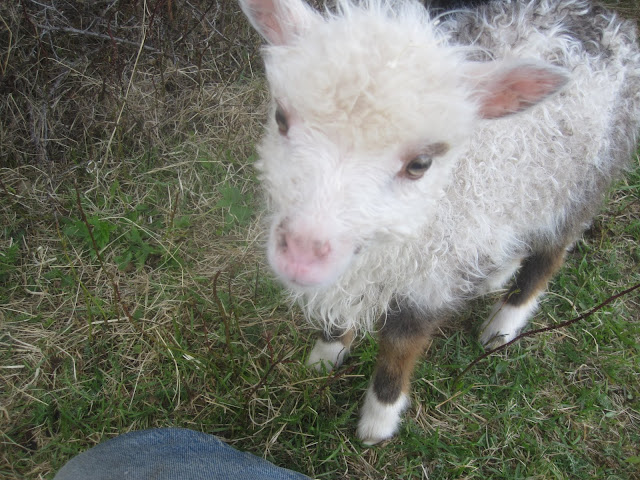
The Spelsau ewes seemed to lamb later than the other breeds and I think we all thought DagrĂºn was too young, but she surprised everyone by giving birth to a little gimmer (female) lamb.  The lamb has been adopted by another member of the B&B group and we're just waiting to hear her name.  She is as beautiful, if not more so, than her mother and I'm delighted to say that this time Blacker is not the father!


 More photos of the B&B trio can be found in this thread on Ravelry and anyone who enjoys spinning and fresh air in Sweden should have a look at Renee's website and see what she has on offer.

Saturday, 26 March 2011

Handspinning Rare Wools DVD by Deb Robson - Not just for spinners!

Little packages from America are always exciting, and the wait for the last one seemed much longer than usual since I'd pre-ordered it earlier in the year.  There is a discussion thread about it in Blacker & Beyond on Ravelry (Ravelry members only can use this link, but it is free to join Ravelry.com)

I've been watching some of the chapters again and, seeing the level of interest from another member of the household, I thought I would post my thoughts about the dvd here as well.


To use Deb’s own closing word - MAGIC

A quote I will remember and use when talking to people about why I get so excited about the enormous variety in wool from different breeds:
“Like telling a woodworker they can only work with pine”.

Right, I shall put my reviewer hat on as per a request from a friend, and for anyone else who might be interested. These are of course my personal opinions!

Photography is superb with one tiny exception that I’ll mention later. I really liked the studio set up - calming and quiet on the eye but nice images of sheep in the back that I enjoyed but weren’t distracting. I want one of those vertical basket supports!

Sound quality was good, gentle music between the sections feel appropriate in nature to me.
DVD menu was fine - you get the option to choose ‘chapters’. For someone who was wanting to get straight to the chapter for a particular breed, you would need to know which ‘class’ that breed fell into.

If you put the dvd into a computer you can download a very informative pdf with a list of every breed covered in the dvd and information about the classification of every breed regarding ‘rare’ status from RBST and American Livestock Breeds Conservancy - it was very helpful to be able to see that information from the 2 organisations on one table.

Looking through Deb’s fleece preparation equipment and supplies, along with her talking about why she uses what she does, was fascinating and I learnt a great deal.

The first chapter of dvd 1 - what is a breed, what makes it rare, and why should we care? - was extremely informative, and Deb really does manage to come across ‘on film’ with the same passion and enthusiasm that I’ve experienced listening to her in person. Absolutely packed full of interesting facts and at times, yes, I did get emotional. The future existence of some of these breeds is not guaranteed.

The way the different breeds were grouped seemed to me to be logical and sensible.

The close up filming was good and you could clearly see what Deb was referring to in a fibre or yarn, but as we all know it is difficult to show fine detail in very dark colours. When one ‘black’ yarn was displayed on a mid grey surface that didn’t help. Although I could manage to see everything, I felt I was having to make a conscious effort to do so. All the subsequent very dark fleeces and yarns were on a lighter brown woven mat and that really improved the ease of viewing them.

I learnt a vast amount about both the breeds and their wool, and how to prepare and spin these very different fibres.

There was however also a great deal of information for knitters, weavers and crocheters and I don’t think the title of the dvd gets this across. I suspect the pragmatic need for a short title may have played a part in this. I wonder also if the spinners involved with the production of this dvd perhaps didn’t realise that non-spinners would find a ‘spinning’ dvd interesting and useful, even when it has such a lot of information about the breeds and fibres.

Many who don’t spin would still want to watch a discussion about the spinning qualities of wool from different breeds, and this will enable them to evaluate breed specific commercial yarns better and could be valuable to them in their yarn purchases. As someone who has only been spinning for a few months but was knitting with breed specific commercial yarns before then I would definitely have found this dvd extremely useful and interesting when I wasn’t a spinner. Deb does also show samples of commercially spun yarns from some of the breeds and discusses them, so I would have no hesitation in recommending this dvd to non-spinners.

I’m very pleased I own the dvd because there was so much information there that I've already found myself going back to watch individual chapters again.  It was a very enjoyable 3hrs  watching from start to finish, and I’m very pleased I did that, but there was too much to take in fully during that one session. This isn’t just a ‘watch once’ experience - this is a dvd that will be an invaluable, ongoing resource for me.

So, would I sit there in real life with knitting, spinning and sheep loving friends and advise them to buy it - you bet! ☺


How to get hold of your own copy:
DVD  can be purchased from Interweave - there is also a preview on this link.  For those outside America, my experience of ordering from Interweaves is that if they have an item in stock then it comes across the Atlantic quite quickly.

Download  is a much quicker way to get it if outside America.

While waiting for the dvd to be released I found it very interesting and encouraging to read Deb's post on her blog

A friend has also blogged about her experience of watching this dvd and you can read her thoughts here

As if all this weren't enough to get lovers of sheep breeds excited, we do of course have the release of "The Fleece and Fiber Sourcebook: More than 200 Fibers, from Animal to Spun Yarn" written by Deb and Carol Ekarius, in a few months time.


Wednesday, 23 March 2011

Knit Camp story published in UK

Back in October 2010 I'd very much hoped I could put the bad part of Knit Camp behind me, and just move on with my new skills (spinning), new interests and passions (rare breed sheep and breed specific fleece & fibre products) and enjoying the new friends I was meeting online and 'in real life' through these interests.

Abhorring the way an individual has behaved towards others does not mean I wish them ill.  In fact I very much hoped that Jo Watson had learned from her multiple and serious mistakes, would gain some benefit to her own peace of mind by continuing to make what reparations she could, and very importantly that she would gain the insight to appreciate she does not have, in my personal opinion, the necessary character and business skills to take on what she had attempted in the past, or similar future endeavours.

It was with great shock then that  we realised she was in fact moving on into new business ventures in the knitting and craft arena.  A number of us were appalled at the thought that she might, in future, do to other people what she had done to the hundreds affected by Knit Camp.  At times UK law, especially relating to companies, can be frustrating and appear not to offer protection from those wilfully deceptive, fraudulent or incompetent.  In early November 2010 the thought was that it was probably largely the latter that could be applied to Jo Watson.  My personal opinion has now changed.

The tutors had made multiple complaints using the regulatory bodies that do exist for companies.  However any result of that may never be made public.  Public information on the internet about Jo Watson and her new endeavours was shared on Ravelry.  Then the Americans did the 'cavalry charge' over the hill and an article, Unhappy Campers, was published in Yarn Market News in November.  This is a free print and on line trade journal for the USA and, I think, the international yarn industry.  Sadly the article itself wasn't available on line through Yarn Market News.  The content of the article however did reach people outside their normal readership.  I've read it - a well written, good and accurate summary of most of the main events, and pretty damning (in my opinion) of two of the people it named - Jo and Doug Watson.

For 'us Brits' though it was still frustrating that the story wasn't available to the British public.  Also, having been dragged back into the Knit Camp aftermath, some of us on Ravelry started trying to think laterally about the facts and information that were either publicly available, or that we and others might unknowingly have in our possession.  Some interesting possibilities presented themselves.  Miss Marple would have been proud of what people uncovered and posted about that was available in public places for anyone to read - it was just a matter of finding it.  A very vague post requesting certain information from campers also produced some very revealing facts - my thanks again to all those Ravellers who took the time to send information to me - it was more valuable than may be apparent at the moment.

 Image from Wiki

OK - this is going to be frustrating for many of you reading this.  If I say what we found out and what was done with it, then someone might be alerted.  So my apologies, but I'm sure all of you reading this (well, excepting one obvious person) will understand.  There is also the possibility of course that there may be future developments related to this that are in the public arena.

With this new knowledge at hand, and still frustrated that 'the story' hadn't been told in the UK, but having the USA publication of the story as 'new news', I tried a long shot.  I contacted a certain UK publication with all this information.  Bullseye!  Over the Christmas and New Year period one of this publication's reporters was busy sifting through all the reams of information that I and some of the tutors sent to her.  Then we waited - it's a 2 weekly publication and the first one in January was a day later than usual coming out.  No article - too much other news.  Two weeks later on the Monday evening emails between the reporter and myself as the sub editors (I think that's the term)  decided what was going in the next issue.  Not good news and frustration for both of us.  She did however say that if it kept being bumped, then she had other publications in mind that might pick it up.  Time passed and I stopped even rushing for the publication when it came (we've been subscribers for years).

One thing that did crop up as a result of the reporter doing the investigating was that we found out that the University of Stirling was owed, by Events by British Yarn Ltd an amount of money that meant they decided to take action. (bottom LH corner).  The result of that was a Winding-up Order and an Official Receiver appointed as Liquidator.  A Raveller made contact with the University of Stirling and all the information people had gathered from public websites and documents, or sent from their personal records, has also been sent there and we've been told that their lawyers are finding it helpful.

Then something very exciting happened on 10 March that caught me totally by surprise - and full credit must go here to a Raveller, Judithknits, who spotted this and posted.  The story had been published by The Oldie.  Quick email to the reporter and yes, it was her work.  (thank goodness after all the time and effort she'd put in!)  The post was made in the evening so I had to wait until the next day to track down where to purchase The Oldie.  Not easy to find.  WH Smiths and Waitrose may be the only nationwide outlets that stock it.  There were then stories appearing on-line of people trying to track one down in their local area, and of course the international interest was very great.  It appears I wasn't the only person who emailed or rang The Oldie to plead if the article could be published on their website when the current issue was off the shelves.

I now have enormous respect for The Oldie team.  They could have just left things and let the magazine sell out in the shops, or have promised it would go on the website next month.  But no - that appears not to be how they operate.  Virtually the next day the article was there - up on the website - where people all around the world could read it.  (Link doesn't not work now, so see below for image of article from The Oldie April 2011)  My view of it - succinctly damning.  Just having the story out in public, has been helpful for many people, especially those in countries that would have dealt differently with the situation through their legal systems, and who feel especially frustrated about how things have happened over here.  We all have a sense of 'natural justice', and in this case there is a feeling that proper justice has yet to be done.  (as a small aside, after reading The Oldie my mid 50's husband asked it he could have a subscription for his upcoming birthday!)

So my heartfelt thanks again to the reporter and The Oldie team - you've done more than you could know.  
Thanks also are due to the University of Stirling for doing what they have done - having an Official Receiver dealing with the financial records of the Jo Watson's company can only help bring justice.

One last point to add.  In the course of all this I received a number of private and confidential messages from people linked in some way to Knit Camp, Ravelry, or Jo Watson prior to Knit Camp.  Confidential is a word I take seriously.  Knowing what I do though, I want it to be known in public  that these people, in how they responded publicly and on Ravelry to certain situations that arose, all acted, (for the greater good of minimising damage to people booked to attend Knit Camp), with great restraint and dignity and accorded Jo Watson a level of courtesy that was in no way reciprocated.


Thursday, 13 January 2011

Spinning carried over the New Year

The title of this post refers not so much to what I've been spinning over the New Year period, but to the fact that I have some photos of spinning and an old spinning wheel I'd taken way back in September and the planned blog post kept getting postponed.  So in the best traditions of tidying things up to start a new year, I've finally put down the luscious bit of lace knitting I'm doing at the moment and have sorted out those photographs.

To be absolutely honest there has also been the imperative of realising that a fascinating article in issue 34 of  Yarn Forward Magazine, which includes the photograph of my Grandma and some of her siblings from an earlier post (Musings from my spinning wheel), also includes the url for this blog.  Sudden realisation - I hadn't posted for a few weeks!

So here at last are some photographs from 2010 of an old wheel and a spinner in Tudor dress at Hardwick Hall.
I was really interested to see the wheel in one of the rooms in  Pockerley Manor at Beamish Museum.  Pockerley Manor illustrates the life of a yeoman farming family in the early 1800s, so I presume that this wheel dates from that period.

The first thing I noticed is that the wheel is very large and doesn't have a treadle.  In fact it looks as if it may have been made by someone who made cart or carriage wheels.  I was rather perplexed about how this wheel could be used until I found a couple of groups on Ravelry - Antique Spinning Wheels and Longdraw Spinners.

My original thoughts that the wheel would be turned by a child, have now been replaced by learning of  the impressive feat whereby the spinner manages both the drafting and wheel turning herself while standing.
This photograph from Wikipedia shows  a Spinning wheel demonstration, producing yarn from wool, at Conner Prairie living history museum in Fishers, Indiana.
Photo shot by Derek Jensen (Tysto), 2005-September-03

Now while I can see that her right arm could be used to turn the wheel, I'd seen in a modern copy of the book, The Luttrell Psalter, a very different position used by the spinner.
 This link shows the image from the original Psalter, dated 1300-1340,
 and this link shows an image from a film made of the Psalter and most clearly and beautifully demonstrates how this sort of wheel was used. (scroll down to below the ploughing)

What I find most interesting is that the wheel itself, to my amateur eyes, appears very similar to that in Pockerley Manor, although there are are 500 years between them.

The Psalter also shows a woman carding, again in a manner very similar to how it is done today and using carders that look as if they could have been purchased today.

These two further photographs from Pockerley show some of the tools associated with spinning.  On the dresser at the back of the right hand photograph is a niddy noddy and lazy kate, again looking very similar to modern versions.


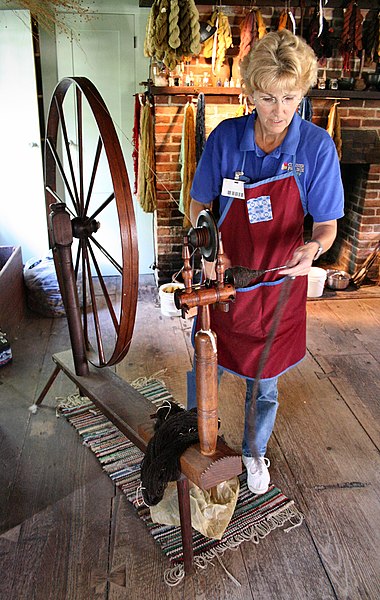
To have a glimpse back into Tudor times, the day I visited Hardwick Hall last September, they had re-enactors  in the hall, including a lady from the local  spinning Guild who was dressed in Tudor dress.


Although her wheel and spinning equipment aren't Tudor, those of you with sharp eyes will have spotted that the wheel is a little unusual.  From what I remember she said about it, and it was lovely having a chat with her, the wheel was 'rescued' at Chesterfield Market and restored.  She thought it was possibly continental in origin.  The wheel has two flyers and is called a Gossip Wheel, although whether it was really able to be used by two spinners I don't know.

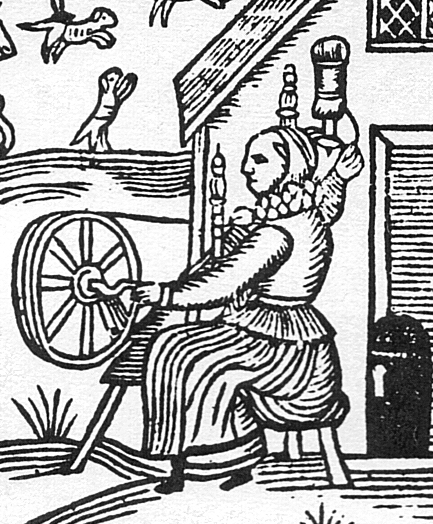
While reading the article in Wikipedia I also found this delightful woodcut image from the early 17th century.  It looks as if she is turning the wheel using a little handle, but also has a distaff and is using a longdraw method.

 This public domain image from Wikipedia is scanned from Horizon Book of the Elizabethan World by Lacey Baldwin Smith, New York: American Heritage Publishing, 1967
Although I am very much a beginner in learning about the history of spinning and spinning wheels (not to forget spindles), what I do know is that certainly before the 1800's, and possibly into the 19th century, my female ancestors would probably all have spun yarn, and for many of those centuries it would have been wool.  English wool - the backbone and driving force of the medieval English economy.

I know that the 3 generations of women before me did not spin, but on my maternal side my great great grandmother, Sarah Armstrong, born in Northumberland at the beginning of the 19th century, may well have spun.  She was the daughter of a farmer, grand daughter of a Shepherd, and she married a farmer who had generations of Northumberland tenant farmers behind him. 

I don't really do New Year resolutions, but one thing that is definitely on my To Do list for this year is to relate what I've discovered about her life, and to see if there is any connection other than geographical with the Blue Faced Leicester sheep.

I'll also do a fuller post about Margaret Jane Walker, the woman who almost certainly knitted the dress in the Yarn Forward article.  Her large family alone tells the story of the early part of the 20th century and were affected by nearly every significant event of that period.