Saturday, 26 March 2011

Handspinning Rare Wools DVD by Deb Robson - Not just for spinners!

Little packages from America are always exciting, and the wait for the last one seemed much longer than usual since I'd pre-ordered it earlier in the year.  There is a discussion thread about it in Blacker & Beyond on Ravelry (Ravelry members only can use this link, but it is free to join Ravelry.com)

I've been watching some of the chapters again and, seeing the level of interest from another member of the household, I thought I would post my thoughts about the dvd here as well.


To use Deb’s own closing word - MAGIC

A quote I will remember and use when talking to people about why I get so excited about the enormous variety in wool from different breeds:
“Like telling a woodworker they can only work with pine”.

Right, I shall put my reviewer hat on as per a request from a friend, and for anyone else who might be interested. These are of course my personal opinions!

Photography is superb with one tiny exception that I’ll mention later. I really liked the studio set up - calming and quiet on the eye but nice images of sheep in the back that I enjoyed but weren’t distracting. I want one of those vertical basket supports!

Sound quality was good, gentle music between the sections feel appropriate in nature to me.
DVD menu was fine - you get the option to choose ‘chapters’. For someone who was wanting to get straight to the chapter for a particular breed, you would need to know which ‘class’ that breed fell into.

If you put the dvd into a computer you can download a very informative pdf with a list of every breed covered in the dvd and information about the classification of every breed regarding ‘rare’ status from RBST and American Livestock Breeds Conservancy - it was very helpful to be able to see that information from the 2 organisations on one table.

Looking through Deb’s fleece preparation equipment and supplies, along with her talking about why she uses what she does, was fascinating and I learnt a great deal.

The first chapter of dvd 1 - what is a breed, what makes it rare, and why should we care? - was extremely informative, and Deb really does manage to come across ‘on film’ with the same passion and enthusiasm that I’ve experienced listening to her in person. Absolutely packed full of interesting facts and at times, yes, I did get emotional. The future existence of some of these breeds is not guaranteed.

The way the different breeds were grouped seemed to me to be logical and sensible.

The close up filming was good and you could clearly see what Deb was referring to in a fibre or yarn, but as we all know it is difficult to show fine detail in very dark colours. When one ‘black’ yarn was displayed on a mid grey surface that didn’t help. Although I could manage to see everything, I felt I was having to make a conscious effort to do so. All the subsequent very dark fleeces and yarns were on a lighter brown woven mat and that really improved the ease of viewing them.

I learnt a vast amount about both the breeds and their wool, and how to prepare and spin these very different fibres.

There was however also a great deal of information for knitters, weavers and crocheters and I don’t think the title of the dvd gets this across. I suspect the pragmatic need for a short title may have played a part in this. I wonder also if the spinners involved with the production of this dvd perhaps didn’t realise that non-spinners would find a ‘spinning’ dvd interesting and useful, even when it has such a lot of information about the breeds and fibres.

Many who don’t spin would still want to watch a discussion about the spinning qualities of wool from different breeds, and this will enable them to evaluate breed specific commercial yarns better and could be valuable to them in their yarn purchases. As someone who has only been spinning for a few months but was knitting with breed specific commercial yarns before then I would definitely have found this dvd extremely useful and interesting when I wasn’t a spinner. Deb does also show samples of commercially spun yarns from some of the breeds and discusses them, so I would have no hesitation in recommending this dvd to non-spinners.

I’m very pleased I own the dvd because there was so much information there that I've already found myself going back to watch individual chapters again.  It was a very enjoyable 3hrs  watching from start to finish, and I’m very pleased I did that, but there was too much to take in fully during that one session. This isn’t just a ‘watch once’ experience - this is a dvd that will be an invaluable, ongoing resource for me.

So, would I sit there in real life with knitting, spinning and sheep loving friends and advise them to buy it - you bet! ☺


How to get hold of your own copy:
DVD  can be purchased from Interweave - there is also a preview on this link.  For those outside America, my experience of ordering from Interweaves is that if they have an item in stock then it comes across the Atlantic quite quickly.

Download  is a much quicker way to get it if outside America.

While waiting for the dvd to be released I found it very interesting and encouraging to read Deb's post on her blog

A friend has also blogged about her experience of watching this dvd and you can read her thoughts here

As if all this weren't enough to get lovers of sheep breeds excited, we do of course have the release of "The Fleece and Fiber Sourcebook: More than 200 Fibers, from Animal to Spun Yarn" written by Deb and Carol Ekarius, in a few months time.


Wednesday, 23 March 2011

Knit Camp story published in UK

Back in October 2010 I'd very much hoped I could put the bad part of Knit Camp behind me, and just move on with my new skills (spinning), new interests and passions (rare breed sheep and breed specific fleece & fibre products) and enjoying the new friends I was meeting online and 'in real life' through these interests.

Abhorring the way an individual has behaved towards others does not mean I wish them ill.  In fact I very much hoped that Jo Watson had learned from her multiple and serious mistakes, would gain some benefit to her own peace of mind by continuing to make what reparations she could, and very importantly that she would gain the insight to appreciate she does not have, in my personal opinion, the necessary character and business skills to take on what she had attempted in the past, or similar future endeavours.

It was with great shock then that  we realised she was in fact moving on into new business ventures in the knitting and craft arena.  A number of us were appalled at the thought that she might, in future, do to other people what she had done to the hundreds affected by Knit Camp.  At times UK law, especially relating to companies, can be frustrating and appear not to offer protection from those wilfully deceptive, fraudulent or incompetent.  In early November 2010 the thought was that it was probably largely the latter that could be applied to Jo Watson.  My personal opinion has now changed.

The tutors had made multiple complaints using the regulatory bodies that do exist for companies.  However any result of that may never be made public.  Public information on the internet about Jo Watson and her new endeavours was shared on Ravelry.  Then the Americans did the 'cavalry charge' over the hill and an article, Unhappy Campers, was published in Yarn Market News in November.  This is a free print and on line trade journal for the USA and, I think, the international yarn industry.  Sadly the article itself wasn't available on line through Yarn Market News.  The content of the article however did reach people outside their normal readership.  I've read it - a well written, good and accurate summary of most of the main events, and pretty damning (in my opinion) of two of the people it named - Jo and Doug Watson.

For 'us Brits' though it was still frustrating that the story wasn't available to the British public.  Also, having been dragged back into the Knit Camp aftermath, some of us on Ravelry started trying to think laterally about the facts and information that were either publicly available, or that we and others might unknowingly have in our possession.  Some interesting possibilities presented themselves.  Miss Marple would have been proud of what people uncovered and posted about that was available in public places for anyone to read - it was just a matter of finding it.  A very vague post requesting certain information from campers also produced some very revealing facts - my thanks again to all those Ravellers who took the time to send information to me - it was more valuable than may be apparent at the moment.

 Image from Wiki

OK - this is going to be frustrating for many of you reading this.  If I say what we found out and what was done with it, then someone might be alerted.  So my apologies, but I'm sure all of you reading this (well, excepting one obvious person) will understand.  There is also the possibility of course that there may be future developments related to this that are in the public arena.

With this new knowledge at hand, and still frustrated that 'the story' hadn't been told in the UK, but having the USA publication of the story as 'new news', I tried a long shot.  I contacted a certain UK publication with all this information.  Bullseye!  Over the Christmas and New Year period one of this publication's reporters was busy sifting through all the reams of information that I and some of the tutors sent to her.  Then we waited - it's a 2 weekly publication and the first one in January was a day later than usual coming out.  No article - too much other news.  Two weeks later on the Monday evening emails between the reporter and myself as the sub editors (I think that's the term)  decided what was going in the next issue.  Not good news and frustration for both of us.  She did however say that if it kept being bumped, then she had other publications in mind that might pick it up.  Time passed and I stopped even rushing for the publication when it came (we've been subscribers for years).

One thing that did crop up as a result of the reporter doing the investigating was that we found out that the University of Stirling was owed, by Events by British Yarn Ltd an amount of money that meant they decided to take action. (bottom LH corner).  The result of that was a Winding-up Order and an Official Receiver appointed as Liquidator.  A Raveller made contact with the University of Stirling and all the information people had gathered from public websites and documents, or sent from their personal records, has also been sent there and we've been told that their lawyers are finding it helpful.

Then something very exciting happened on 10 March that caught me totally by surprise - and full credit must go here to a Raveller, Judithknits, who spotted this and posted.  The story had been published by The Oldie.  Quick email to the reporter and yes, it was her work.  (thank goodness after all the time and effort she'd put in!)  The post was made in the evening so I had to wait until the next day to track down where to purchase The Oldie.  Not easy to find.  WH Smiths and Waitrose may be the only nationwide outlets that stock it.  There were then stories appearing on-line of people trying to track one down in their local area, and of course the international interest was very great.  It appears I wasn't the only person who emailed or rang The Oldie to plead if the article could be published on their website when the current issue was off the shelves.

I now have enormous respect for The Oldie team.  They could have just left things and let the magazine sell out in the shops, or have promised it would go on the website next month.  But no - that appears not to be how they operate.  Virtually the next day the article was there - up on the website - where people all around the world could read it.  (Link doesn't not work now, so see below for image of article from The Oldie April 2011)  My view of it - succinctly damning.  Just having the story out in public, has been helpful for many people, especially those in countries that would have dealt differently with the situation through their legal systems, and who feel especially frustrated about how things have happened over here.  We all have a sense of 'natural justice', and in this case there is a feeling that proper justice has yet to be done.  (as a small aside, after reading The Oldie my mid 50's husband asked it he could have a subscription for his upcoming birthday!)

So my heartfelt thanks again to the reporter and The Oldie team - you've done more than you could know.  
Thanks also are due to the University of Stirling for doing what they have done - having an Official Receiver dealing with the financial records of the Jo Watson's company can only help bring justice.

One last point to add.  In the course of all this I received a number of private and confidential messages from people linked in some way to Knit Camp, Ravelry, or Jo Watson prior to Knit Camp.  Confidential is a word I take seriously.  Knowing what I do though, I want it to be known in public  that these people, in how they responded publicly and on Ravelry to certain situations that arose, all acted, (for the greater good of minimising damage to people booked to attend Knit Camp), with great restraint and dignity and accorded Jo Watson a level of courtesy that was in no way reciprocated.


Thursday, 13 January 2011

Spinning carried over the New Year

The title of this post refers not so much to what I've been spinning over the New Year period, but to the fact that I have some photos of spinning and an old spinning wheel I'd taken way back in September and the planned blog post kept getting postponed.  So in the best traditions of tidying things up to start a new year, I've finally put down the luscious bit of lace knitting I'm doing at the moment and have sorted out those photographs.

To be absolutely honest there has also been the imperative of realising that a fascinating article in issue 34 of  Yarn Forward Magazine, which includes the photograph of my Grandma and some of her siblings from an earlier post (Musings from my spinning wheel), also includes the url for this blog.  Sudden realisation - I hadn't posted for a few weeks!

So here at last are some photographs from 2010 of an old wheel and a spinner in Tudor dress at Hardwick Hall.
I was really interested to see the wheel in one of the rooms in  Pockerley Manor at Beamish Museum.  Pockerley Manor illustrates the life of a yeoman farming family in the early 1800s, so I presume that this wheel dates from that period.

The first thing I noticed is that the wheel is very large and doesn't have a treadle.  In fact it looks as if it may have been made by someone who made cart or carriage wheels.  I was rather perplexed about how this wheel could be used until I found a couple of groups on Ravelry - Antique Spinning Wheels and Longdraw Spinners.

My original thoughts that the wheel would be turned by a child, have now been replaced by learning of  the impressive feat whereby the spinner manages both the drafting and wheel turning herself while standing.
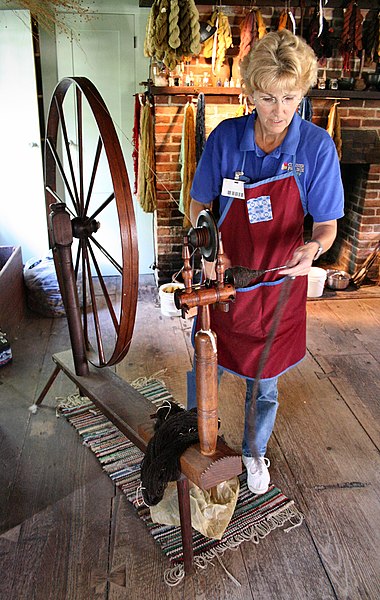
This photograph from Wikipedia shows  a Spinning wheel demonstration, producing yarn from wool, at Conner Prairie living history museum in Fishers, Indiana.
Photo shot by Derek Jensen (Tysto), 2005-September-03

Now while I can see that her right arm could be used to turn the wheel, I'd seen in a modern copy of the book, The Luttrell Psalter, a very different position used by the spinner.
 This link shows the image from the original Psalter, dated 1300-1340,
 and this link shows an image from a film made of the Psalter and most clearly and beautifully demonstrates how this sort of wheel was used. (scroll down to below the ploughing)

What I find most interesting is that the wheel itself, to my amateur eyes, appears very similar to that in Pockerley Manor, although there are are 500 years between them.

The Psalter also shows a woman carding, again in a manner very similar to how it is done today and using carders that look as if they could have been purchased today.

These two further photographs from Pockerley show some of the tools associated with spinning.  On the dresser at the back of the right hand photograph is a niddy noddy and lazy kate, again looking very similar to modern versions.


To have a glimpse back into Tudor times, the day I visited Hardwick Hall last September, they had re-enactors  in the hall, including a lady from the local  spinning Guild who was dressed in Tudor dress.


Although her wheel and spinning equipment aren't Tudor, those of you with sharp eyes will have spotted that the wheel is a little unusual.  From what I remember she said about it, and it was lovely having a chat with her, the wheel was 'rescued' at Chesterfield Market and restored.  She thought it was possibly continental in origin.  The wheel has two flyers and is called a Gossip Wheel, although whether it was really able to be used by two spinners I don't know.

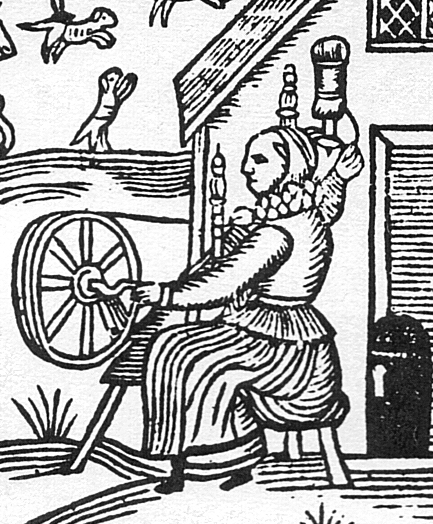
While reading the article in Wikipedia I also found this delightful woodcut image from the early 17th century.  It looks as if she is turning the wheel using a little handle, but also has a distaff and is using a longdraw method.

 This public domain image from Wikipedia is scanned from Horizon Book of the Elizabethan World by Lacey Baldwin Smith, New York: American Heritage Publishing, 1967
Although I am very much a beginner in learning about the history of spinning and spinning wheels (not to forget spindles), what I do know is that certainly before the 1800's, and possibly into the 19th century, my female ancestors would probably all have spun yarn, and for many of those centuries it would have been wool.  English wool - the backbone and driving force of the medieval English economy.

I know that the 3 generations of women before me did not spin, but on my maternal side my great great grandmother, Sarah Armstrong, born in Northumberland at the beginning of the 19th century, may well have spun.  She was the daughter of a farmer, grand daughter of a Shepherd, and she married a farmer who had generations of Northumberland tenant farmers behind him. 

I don't really do New Year resolutions, but one thing that is definitely on my To Do list for this year is to relate what I've discovered about her life, and to see if there is any connection other than geographical with the Blue Faced Leicester sheep.

I'll also do a fuller post about Margaret Jane Walker, the woman who almost certainly knitted the dress in the Yarn Forward article.  Her large family alone tells the story of the early part of the 20th century and were affected by nearly every significant event of that period.

Monday, 22 November 2010

Sheep to sweater - the beginners version

During August, the same week that I started spinning and had my love of breed specific yarn and  fleece raised to new heights, I was able to observe a Sheep to Sweater challenge.  The concept was wonderful and totally intriguing, but for me it was very much something to observe rather than ever contemplate doing.  Well, to be honest, it still is, but I've just had my own beginners mini version and I'd like to share how totally chuffed I feel about the whole thing.

 In one sense it started with an impulse buy at The Knit Studio in Newcastle a couple of weeks ago.  Despite having enough fleece stacked up in pillow cases to consider insulating the house, this little plait of Shetland tops below found it's way into my bag

This image shows the label.  The reason for the photo having been taken while it was draped over the spinning wheel will be explained.


I just fell in love with the colours, although I had no idea how it would spin up.  However with it being Shetland I had confidence that I could spin it.  I've come to have a great respect, as a beginner, for Shetland fleece, which is proving to be most forgiving and to do its best to spin beautifully regardless of what new technique I'm trying or how irregular my drafting and twist is.  

While I'm singing the praises of Shetland I should add that my love affair with it started when I began doing Fair Isle knitting and steeking.  Shetland is a yarn that was created to do lots of friendly things when 2 colours are knitted together and that behaves impeccably when steeked.  One swift cut of the yarn and the cut edges just curl back nicely and give a little reassuring cling to the reverse side of the fabric, removing any horrific nightmares of hours of knitting unravelling.

So my pretty little plait came home with me and entered the realms of what I've learnt through Ravelry to call my 'Stash'.   I now have a yarn stash and a fleece/fibre stash.  The former is actually fairly modest by some standards since I had a big clear out and found new homes for a lot of yarn that I knew I wouldn't knit up this side of the mid century.  The latter is big in volume, but does have the benefit of insulating the room it is stacked up in.  I do however have a number of whole raw fleeces and distinct memories of some lovely people who know a lot more about fleece than I do telling me that it can't be kept forever in its present state and that some processing should be done before Christmas.  That's this Christmas - the one just a few weeks away.  Say no more.

The pretty little plait might well have remained in my 'admire and fondle' pile if it weren't for a little knit along challenge that was proposed on one of the Ravelry groups I'm in.  The challenge was to pick something small and quick to knit, post photos of the yarn, pattern and everything needed to complete it by Friday night and then to finish it by Sunday night.  What a lovely idea, and reading through the thread, lots of people also thought this was a good idea and lots of photos of patterns for knitted penguins and other small items appeared.  I should add that this is a group entirely moderated by penguins, but it is one of the British groups on an American heavy site, and one thing Brits are good at doing is chatting (lots) and being delightfully eccentric.

My personal challenge was that I would be spending most of Saturday at Tynedale WSD Guild spinning.  I'd organised puppy sitting and was really looking forward to a day of spinning with lots of lovely experts on hand to answer my innumerable queries.  Plus Tynedale does awesome shared lunches - I mean this is a Guild that takes the concept of a communal lunch to a whole new level.  Then I thought about my pretty little plait, and came up with the 'clever' thought that I could spin this plait on the Saturday and knit a head band to keep my ears warm when wearing my cycle helmet.

Now all experienced spinners out there will have seen the size of the plait, be aware of my novice spinning skills, and will be experiencing some amusement at my plan to 'spin' the whole plait in one day.  They will also have thought ahead to the little steps (ok, not so little) that I've forgotten about that come between spinning and knitting.  Things like plying, skeining, washing, drying, winding.  The bits of my very nice beginning spinning book that I hadn't really got to yet.

So, I take my photo of the pretty little plait with the equipment I'd need to turn it into a headband.  The multiple needles are because I wasn't sure how thick the yarn would be, so I didn't know what size I'd end up using.  I load up the car, not forgetting the essential contribution to lunch and swan off for a day of puppyless freedom away from the house with its constant reminders that housework fairies no longer exist and ironing bags can multiply overnight.  

I must add, as Christmas is so close, that when I was recently having a frantic search for my Beloved's black concert shirt, that I came across all the Christmas table linen still un-ironed from last year.  No doubt it will remain lurking menacingly at the bottom of one of the ironing bags until Christmas Eve, although that does have the benefit that it can go straight from ironing board onto the table, missing out the folding and getting creased bit that most people put in the middle at some point during the year.

Dear future descendants, it would be impossible for me to hide the fact that housewifely tasks do not feature high up my list of priorities, and most photos you may find of the interior of the house have been carefully staged, sometimes involving that time honoured process known as "bung it behind the sofa".  This is a skill that some people, including myself, have acquired over years of practice, resulting in the ability to 'clear' a room in less than the time it would be polite to keep an unannounced guest standing on the doorstep.
I have a large sofa!

Anyway, back to Saturday and the Guild.  Lovely people that they are, any hysterical laughter concerning my weekend plans was carried out where I couldn't hear it.  There was a little mention of the word, brave.  This was from someone who has years of spinning behind her and can actually plan what thickness she wants to end up with and knows what ratios are.  But it is a lovely Guild, so I also got some essential tips to help me on my way.  I'd thought that I needed to let my spun singles rest before plying.  I was told this wasn't essential, but that washing the yarn between plying and knitting was important and would make a difference.  I realised that my original plan to spin for a day and a bit, spend 5 minutes plying and then whip up the head band in a couple of leisurely hours on the Sunday afternoon (that I have done before - headband in the round is a quick little knit) would need some serious adjustment.
In order to get the yarn dry after washing I would need to do all the spinning and plying before going to bed on Saturday night.  Right!

I got about half the pretty little plait (seemingly growing in size throughout the day I should add!) spun at Guild, aided by the fact that everyone very sensibly spun during the AGM.  I do like a group of people that share my priorities.  I'd forgotten to take my camera, but was able to find it when I got back.  Tea became DIY meal - fortunately my Beloved is used to this concept by now and just got on with it.

So this is what happened during the next few hours:

 I spun the tops onto 2 bobbins to make plying easier.  Oh I should add a bit of technical stuff here - I was after speed as much as anything so opted for a long backwards draw and was aiming for a finished plied yarn of about 4ply thickness (fingering to anyone reading this who lives the other side of the pond).  A bit of judicious weighing of the plait helped me to get equal amounts of weight of yarn onto each spool.  I also pull off quite short bits of bits of tops, pull them apart from the end to loosen up the scales, (I think the term Rolag is coming in somewhere here) and then fold it over my index finger and spin woolen from the end of the folded bit.  I'm quite sure there is a far more elegant and concise way of describing this, but anyway, it's a way that works for me.

What had quickly become apparent during the day was the very pretty colours the painted tops were producing when spun.  The yarn half filled the bobbins, so I was hoping that when plied it would all squeeze onto one bobbin.

To speed up the spinning and slow down the speed of my treadling I moved the drive band onto the next groove down on the bobbin, although this did make treadling harder work as the bobbin filled up.  Oh, and I have an intermittent squeak - a clunking sort of squeak.  I think it's related to the way my poor wheel get dragged around, carried through the centre of Stocksfield, and bangs around a bit in the back of  the car.  I can see why people end up with more than one wheel and why their collection includes a travelling wheel.


Now it will be obvious from the photographs that by this time it was dark outside.  In fact, by this time we were well into the 'wee small hours'.  If I was going to achieve this challenge then the yarn had to be washed before I went to bed so it could dry 'overnight' - well have a few hours at least to dry.  Overnight was by now becoming a rather more reduced concept than usual.


Finally, about 2am, the plying was finished and as you can see above it just squeezed onto the one bobbin.  It had taken me considerably longer than the 5 minutes I'd visualised.  I don't know why I have an image in my mind of plying being something really really quick. 

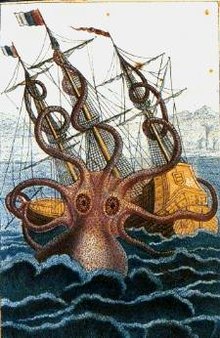
Last time I'd done it I'd ended up in a dreadful tangle with the singles wrapping round each other and themselves and anything else that came in their reach - it had been like having an overexcited Kraken at my feet.

Fortunately I got some essential tips on the correct use of a Lazy Kate from people at the Guild, and it did make a real difference with the tangling issue.  It still took a very very long time though.

The next stage was the Niddy Noddy.  Mine was quickly assembled and the niddying or noddying commenced.  By this time Jodi (the Guide Dog puppy, now 8 mths old) had realised that there was still someone up and about so she came into the front room to investigate.

My Niddy Noddy gives a full wrap of 1.5m, so a quick count of the number of wrappings, 150, told me I had 225m of yarn.  At this stage it was still looking sort of like 4ply thickness, although it's most frustrating when the 2 singles being plied together have either their thickest or their thinnest bits coinciding, rather than nicely cancelling each other out.
Anyone who knows dogs will recognise the expression on Jodi's face.  What she really wants to do is have a good investigation of this exciting thing that has been waved in front of her face for several minutes, but she has just been told to "Leave It", and is not impressed.

Whizzing on through the next bit which involved some figure of 8 tying of the skein (or is it hank?) so that it would all stay together nicely during the washing and drying and not do Kraken things in my sink.  I then realised that 'washing', according to the book, meant 'soaking for 20 minutes' in warm water with a bit of washing liquid added.  20 minutes at that time in the early hours is a very long time!  It did give me time to assemble the towels for drying/squeezing and the hanger to hand up the hank/skein - I know one is the untwisted and one the twisted, but I can't remember which way round just at the moment.  But anyway, you know what I mean.  After the soaking and realising that this miraculous 'blooming' was occuring, then a quick rinse in clear water with a dash of white vinegar (yet another use for white vinegar) and then a final rinse in clear water before the pressing with a towel.  Then, just about the time when the dawn chorus would have been starting if it had been summer, the hank was hung up on a coat hanger to dry 'over night'.

Needless to say I was not up bright eyed and bushy tailed at  my usual 6am the next morning - I wasn't anything at 6am other than comatose, and finally crawled out of bed just in time to grab Jodi (fortunately my Beloved had done the essential feeding of the ravenous hound at her usual time) and dash to Church with her - being Family Service it meant I could combine Church and her training trip into one.  I did actually make time to check the yarn - unsurprisingly it was not completely dry.  No fear, I was sure I'd heard someone at Guild mutter something about radiators, so the yarn was flung onto a radiator to dry while I was out.


Now anyone who has actually read all of this may have some recollection of the time I knew it would take to knit a cycling headband, and be wondering why the rush at this stage.  By now I'd reached the stage of having a finished yarn, so a leisurely afternoon of knitting should be all that was left.

The trouble is, as you can see from this photo, I'd ended up with a very beautiful looking yarn.  Even with the novice hand spun look of the structure of it, this was to me a very pretty yarn indeed.  Much too pretty in fact to end up hidden by a cycling helmet.  I also had a whole 225m or so of this lovely yarn.  There was only one reasonable solution.  I had to knit myself a proper hat.

Now I'm not the fastest of knitters so I knew from experience that even knitting a plain hat would take several hours.  I also thought it would be a good idea to knit a swatch to see what thickness of yarn I'd ended up with.  It looked, on average, like something between a 4ply and DK, but my attempt to use a WPI tool had failed miserably.  Even trying it on commercial yarns of known thickness had failed to give me a figure that matched the information on Ravelry for those yarns.  I obviously need to do a class on how to measure WPI.  

First though I needed to wind the hank into what I understand is called a 'cake'.  I used to wind what are commonly know as balls, but they do tend to skitter about rather a lot when knitting with them, and skittering and balls mixed with puppies ends in tears - always, without fail.  Fortunately I'd been taught to wind a centre pull 'cake' on my thumb (thank you Annie), so this was a fairly straightforward operation, all the more so since I'd acquired a swift and released my Beloved from the hank holding task.  Difficult to hide exciting little impulse purchases of yarn from others if someone else has to hold it for you for winding.  Anyone with a guilty stash needs a swift.


Swatching was more successful though - I should add that I was cooking Sunday lunch through all this - my Beloved was a little uncomprehending about what I was up to and why I was rushing around and staying up to Silly O'Clock, so I felt one of my roast lunches was called for at this point to deflect him from the important activity of the weekend.

Anyway, I ended up with finding that 4mm needles gave a lovely feel to the knitted fabric and it gave me a gauge of 22 stitches to 10cm.  Equipped with that information I hit the Ravelry pattern search and found a top down plain hat that promised to offer what I was looking for.  Heads are Round from the top down seemed to be what I needed.

Finally, after lunch, I was able to start knitting.  A slow start when I realised I needed to look up a figure of 8, or magic cast on, but eventually I found instructions I could comprehend in my sleep deprived state and the knitting commenced.  I should add that lunch had been a bit delayed, so it wasn't until about 4pm when I actually started knitting.  I had considered trying out my new and still unpractised continental knitting skills, since this can be a quicker way of knitting, but I decided the possibilities for a tension disaster or late evening frustration was too great, so I stuck with the familiar but slow.

It was actually pretty miraculous and wonderful actually knitting up something I'd spun myself.  It didn't all fall apart in my hands, and even better, the inconsistencies in the yarn seemed to hide themselves in the knitted fabric, just leaving that 'handspun' look about the fabric.  It was going so well that I decided, after the increasing and shaping had finished, to include a little patterned border before the ribbing.  Obviously by this time tiredness was influencing my judgement.  At about 11pm on the Sunday evening I posted this image into the challenge thread.  Fortunately there were still some Banterers around and I got some lovely encouraging replies to my decision to tough it out and keep knitting to finish it before I went to bed.  That was the challenge - not to finish on the stroke of midnight - just to finish before going to bed.


Finally at about 2.30am it was finished.  My hands ached, but it fitted, it looked gorgeous, felt amazingly warm, and I even had a little bit of yarn left over.  Knitting top down had been tricky to start, but it had saved me hours of 'will there be enough yarn' worry.  I knew that if I had run out, that using a different yarn for the turn up or brim could have been made to work.  Happily though that wasn't necessary.  As per the 'rules' of the challenge I posted the photo of the finished hat and crept off to bed.  It was so worth it though, and has given me a new perspective on what can be achieved with spinning.  So that's it, I've done it, I've taken a fibre you could tear up easily and scatter to the wind and made it into a beautiful, functional item.
WOW - right chuffed. ☺

Friday, 5 November 2010

One glass of grape juice. Or why I didn't get any knitting done this afternoon

The beginning of this tale has not been photographed – I mean, how many of us, at the beginning of a 'simple' event in the kitchen think to photograph it.

We have a grape vine growing in our south facing back yard. It was planted to be trained across the yard so that the leaves would shade the kitchen which has a lot of glass along that wall. It's also nice to sit underneath it when eating outside during the summer. The shading effect hasn't been quite as effective as I'd imagined, but after 3 years of training, pruning and tlc the vine is there to stay. This year, for the first time, we had grapes. Quite an achievement I thought for a northern outdoor vine.

A rather alarming tasting in September suggested that the grapes were of the red rather than green variety. I left them hanging. Despite an early autumn that didn't even attempt to be an Indian Summer the grapes did start turning a rather attractive purple colour during October, but as gales started to rage we had to pick them all before they were blown down. 

A quick tasting revealed quite an intense flavour in the darkest grapes, but there was a lot of pip and thick skin involved. Having spent most weekends during October at Apple Events and observed juicing of apples I decided the solution would be to turn our flavoursome grapes into juice. I'll skip over the rather tedious choosing and purchasing of a juicer, but we ended up with a juicing attachment for the kitchen workhorse – my food mixer.

By now the grapes had been sitting in the fridge for a few days, so there was no time to waste. I separated the purple and 'reddish' grapes from the stalks and the green grapes and filled 2 colanders. After rinsing the grapes I opened the juicer box. This was where it started to get "interesting" – this is my polite, possible future grandchild-friendly term for what actually happened.

 Having failed to take a picture of my overflowing box of grapes, this is what was left after removing the 'ripe' ones.

The 36 page instruction book had one page of diagrams and one page in English. This juicer is obviously shipped to every country in the world, and a couple of planets as well. That one page of English contained the assembly instructions, the 'how to juice' instructions, the 'warnings' (no, I hadn't thought of juicing underwater using my fingers instead of the pusher!), instructions on how to prepare the food, how to clean the juicer and finally the warning never to immerse the base in water. Given that said page is 21 x 10 cm, you'll appreciate the brevity of all these essential instructions.

However I was in full 'homemaker' mode and looking forward to a well earned afternoon of knitting at the end of a busy week. After all, I just had to pop the grapes through the juicer and then have a little sample drink of the clear fragrant, jewel coloured juice before putting my feet up and finishing my sleeve. Rolling around the floor with hysterical laughter is allowed at this point, although you may wish to include a glass of something that will anaesthetise you for the rest of the tale.

Dear family descendants – it took rather longer than anticipated to get the ****** juicer assembled and perched on top of the food mixer. I then discovered that feed tube was rather narrow and the shape of a kidney bean. The grapes had to be inserted by hand, virtually one at a time. By now I'm realising that future plans for juicing apples will include a lot of chopping and I am regretting not having purchased the juicer that said it could take whole apples.


I eventually ended up with a system that involved popping the grapes, one by one into the food tube, switching on the mixer, ramming the pusher down the food tube and trying to keep the plastic jugs in the right place so neither juice nor bits trickled onto the work surface. The ratio of pulped bits to juice was not quite what I had imagined. In fact 2 whole colanders of grapes was being reduced to about 200ml of juice. This was my entire grape harvest. 3 years of lovingly tended grape vine and half an afternoon of ******juicing was giving me 200ml of juice!

I looked at the vast mound of bits and decided that there was still a lot of juice lurking in there. It seemed eminently sensible to run the bits through the juicer again to extract all that 'waste' juice. After all there wasn't anything on the one English page of the instruction book telling me this wasn't a good idea. Plus, the bits poured into the feeder tube much quicker than the whole grapes had done.

With renewed enthusiasm I ran the bits through the juicer, not once but twice more. What a prudent home-maker I was, extracting every ml of clear fragrant juice from our grape harvest. Sadly I was so busy noticing that the volume of juice had almost doubled that I failed to notice that what was coming out of the juicer spout was rather lacking in either clarity or jewel red colour. In fact it resembled the sort of brown sludge you see in the waste oil bucket in a garage. My beautiful juice had acquired a sort of brown 'whole food' look about it. For those of you who have any memories of whole food cafés in in the 1970's, staffed by earnest sandal wearers, it had 'that' sort of look about it.


Time for plan B. Time being something that was quickly running out I should add. The knitting was starting to acquire cobwebs. First idea was to pass the soupy juice through a sieve. While it captured some of the sludge and the odd grape that had escaped being individually placed into the feeder tube, the smaller quantity of juice I was left with still looked like primordial soup. Next plan involved one of the muslin squares I use for making elderflower
hooch cordial placed inside another sieve. This was too efficient and very little trickled through. Squeezing the muslin to try and encourage things along went a little wrong and great dollops of primordial soup surged across the worktop and trickled onto the floor. By now I had every plastic measuring jug I owned in use and if the 'soup' had been red the kitchen would have resembled a serious crime scene. Final attempt involved the jelly bag I should have used in the first place and the results were acceptable. The volume was back down to about 200ml.


Anyone who has read this far and not resorted to a glass of some strengthening liquid or a strong cup of tea is advised to drink one now, while I divert to a textile aside from the juice story.

As I moved the chaos around the kitchen I noticed that the muslin had turned a rather gorgeous muted neutral colour.  The sort of colour that goes with everything, that you search the world for in a yarn, or spend hours trying to achieve in home-dyeing, but never quite find in the perfection that was there in my square of muslin.


I stood there amongst the ruin of my kitchen and tasted the juice. A mere sip was enough to tell me that the couple of grapes I'd tasted after picking were probably the only grapes that were ripe. Yes, there was a pleasing complexity of flavour, but my 'tubes' were being seared more effectively than I'd ever experienced with the strongest vindaloo curry.

By now it was dark outside and the knitting was becoming petrified. Deciding that the French were experts in the fruit of the vine, and having read that they added all sorts of things to their wine, I reached for the sugar. The result was palatable, just.

At this point my dearly beloved arrived having been on a train for 3 hours. He may have been expecting a warm welcoming kitchen and a hot meal – he got a glass of juice shoved in his direction to distract him from the state of the kitchen. To give him his due he very quickly seemed to realise what I might have been up to for the better part of the afternoon and early evening. He took one sip, announced it seemed to be very good for his virus ridden 'tubes' and suggested he have a glass of wine and meal before tackling the Grape Juice. There was some mention of the flavour improving with a little standing in a warm kitchen. He seemed very keen that we should divide the Grape Juice between 2 glasses and have a 'shared moment'.

As I write the glass of Grape Juice is still standing on the kitchen work surface.


I shall leave it there. You don't need any details of the clearing up or the intricate operations required to disassemble the juicer so it could be washed – oh and don't forget the bit about not immersing the base unit in water. I did! Just imagine the worst case scenario, take a swig of whatever fortifying drink you have to hand, and take your imagining several stages nearer to total disaster meltdown.

Ah, the joys of home making............

And yes, now we've eaten and drunk wine, we have shared some far pleasanter than anticipated sips of an intense, fragrant juice.  The 'moment' was a little tarnished however when 'he' (he's not getting any 'dearly beloved' after this) started trying to work out the cost per ml of producing the Grape Juice - I feel his final tally of 30p per 1 ml grossly underestimates the value of my labour!


Tutor Group Fund
There is however a lovely piece of news I'd like to finish with. The knit camp tutor fund I mentioned in my last post did start, more than achieved the minimum I had dared to hope it would, and the benefits for everyone who joined in went far beyond the purely financial. The story is told much better than I could by some of the people involved on both sides of the fund in their blogs. 

The company that organised knit camp still owes a vast amount of money to the tutors, and much smaller amounts to many of the people who attended. I hope one day that justice at least will be served.

Friday, 24 September 2010

September has been a whirlwind

I've been busy.  Not just physically busy, but also very preoccupied with a number of things, mostly exciting, but one of them has been something that has deeply offended my sense of justice and morality.

It relates to the Stirling Knit Camp that I mentioned in my entry for 19 August.  I've just read again what I wrote, still then on a 'high' from the wonderful experience I'd had and excited about new skills gained and exciting new chapters opening up in my life.  I'd realised in the few days before the event started that there were problems, but I had no idea of the extent of these, and I guess I trusted the organiser.  I've organised much smaller scale events myself (think Guides, tents, field) and despite my meticulous planning, some years things just didn't go to plan and we had to adapt and work around problems.  How wrong I was to have thought the Knit Camp problems were of this nature, and indeed to have trusted the organiser.

Now, at this point, you may be wondering how what I've written above can be about the same event I wrote about in August.  The answer is humbling and simple.  Everyone else who was involved in the event including tutors, volunteers, and employees worked exceedingly hard to bring about all the things that were great about the event, and, indeed, they pulled it off to a remarkable extent.  The vendors got creative with sign posting and greatly improved the market place at the end of the week.  The attitude of all the other people I took classes with, knitted with, and had fun with, also helped.  It was awesome in itself to be mixing with knitters from so many different countries and we generally accepted things as they'd turned out to be and had a really good time, despite everything.

Then gradually over the weeks after camp the whole dreadful truth started coming out.  The story from  a Tutor's point of view is best read in this post,   better expressed than I could do so here.  Basically, the reward for most of the tutors for all their 'above and beyond' efforts was not to be paid and not even to have their travelling and other expenses refunded.
One of the lovely people I met, Liz, also writes a blog I enjoy reading and she has written with integrity and honesty about her Knit Camp experiences here.

So what next you may ask.  Am I going to move on, doing lovely things with my knitting needles and spinning wheel?  In one sense, yes.   The good bits of the Stirling experience have inspired and excited me, altered my lifestyle and changed what I do. To embrace all that is to honour the efforts that people put in to give the 'campers' a fantastic week, despite everything.  

But I do tend to be a bit proactive about things.  If I get an idea then I try and follow it through.  Something that started cropping up in peoples' posts on Ravelry was their sense of appreciation and gratitude for what the tutors and others had done at knit camp, and a wish to try and help once the horror of unpaid tutors was revealed.  This echoed my own personal feelings.

So I've been setting up a scheme that will enable people to fulfil their wish to help the group most affected financially; the tutors.  What has taken the time is creating a scheme that is so professionally managed and so 'squeaky-clean' that people who have had their trust sorely tested will have the confidence to use it.  Doing things this properly takes time (note to anyone planning a future knitting event!). Even the Accountancy Firm I have engaged to set up and run the scheme has encountered delays with PayPal in setting up the account, but it is finally coming together and we, that is the amazing community of knitters I've grown to know and love through all this, will very soon have a means of safely donating  funds for the Stirling Tutor Group.  And love is also there for my husband, who gave a wholehearted affirmative to my suggestion that we cover all the costs of the Accountant, so that every penny and every cent raised will go straight into the Tutor Fund.

So now I'm feeling a bit like a woman in her 41st week of pregnancy.  A bit frustrated by delays (but it is so important not to 'launch' until every last detail is properly in place) and a bit anxious about what will emerge.  I know the scale of the monies owed, and I know how many people were keen enough to get involved to contact me personally, but I have no idea how much money will be raised and donated.  I hope that at the minimum it will cover the amount the tutors paid out in travel and other expenses, I dream it may be more.  What I do know is that already, just for the tutors to know that there is so much concern and gratitude and support for them from so many people has been of emotional help.  I also know that people have found it helpful that there is going to be a scheme that will enable them to express what they feel in a practical way by giving.  

And now for a discursive interlude with the Tudors - perchance not as discursive as it first appears.

Time for a picture.
This is the imposing frontage of Hardwick Hall.  Built in the 1590's for Bess of Hardwick, Countess of Shrewsbury, it sits on top of a hill overlooking the Derbyshire countryside, and is visible for miles around.  Remembered in the phrase: Hardwick Hall, more glass than wall, it is a conspicuous symbol of Bess's wealth and power.

The six upper rooms have balustrades with Bess's initials ES, for Elizabeth Shrewsbury, clearly visible.
Ostentatious is a word that might come to mind.  Certainly Bess didn't lack ambition.  Her wealth grew not just through her 4 marriages, but through her careful management of her estates.  Five of her six surviving children she managed to marry into noble families, and the sixth into Royalty.

This is a painting of Bess as a young woman

  
Here as an older woman, now the richest woman in the country after Elizabeth I.


My impression, as I looked at both paintings during a visit to Hardwick Hall yesterday, is that Bess's experiences have hardened her.  It wasn't an easy task for her to achieve what she did.  She survived an attempted poisoning and charges of embezzlement.   She held positions at Court and some of her children had Royal Godmothers.  She skilfully negotiated her way through and around the Elizabethan laws of succession and inheritance at a time when women had few property rights.

In many ways an admirable woman with a remarkable grasp of the minutia of law and financial affairs, who succeeded in ventures where other lesser women or those with less care and attention would have failed spectacularly.

This illustrates her position in Elizabethan society


Bess also enjoyed gambling, as illustrated by this beautiful inlaid table at Hardwick Hall.  Unlike many gamblers who take too many risks and end up losing everything, Bess's accounts of 1593 show that her expenditure of £8,500 was significantly less than her income of £9,500.


Ambitions sometimes bear a cost, even for someone of the stature and ability of Bess.  In spite of Bess's intelligence, skills and accomplishments, a level of attributes shared by few other women, these costs affected other people.  Not all of her children's marriages were happy and the story of her granddaughter Arabella Stuart, a possible contender for the throne of England,  is tragic.  

Arabella Stuart as a teenager.

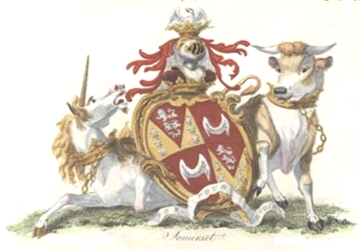
Arabella did marry Sir William Seymour, 2nd Duke of Somerset, although both led tragic lives.  Below is the Somerset Coat of Arms, complete with unicorn.